Key Takeaways
-
Adjustable-speed fans suit changing conditions, like shifts that move between patrol cars, foot beats, and indoor stops, because you can raise airflow at peak heat and lower it when things cool off.
-
Fixed-speed fans offer simplicity with a single preset level, which works well for steady conditions, but you cannot turn them up on a hotter-than-expected day or down to save battery.
-
Lower fan settings generally stretch battery runtime and reduce noise, while higher speeds move more air but drain power faster, so reserve peak speeds for the hardest work or hottest moments.
-
Battery runtime claims vary widely by product and test method, so compare manufacturer specs and how they were measured rather than relying on a single headline number.
-
Fan cooling depends on sweat evaporating, so it feels weaker in humid conditions; pair it with hydration, rest breaks, and your employer's heat-safety rules.
-
A ventilation fan is a comfort tool, not a safety plan, and any cooling add-on must never block armor coverage or limit movement.
If you wear body armor for a living, you already know the feeling. Your shirt sticks to your back, your focus drifts, and the shift feels twice as long. A body armor fan can help, but one big question comes up fast: should you pick an adjustable or a fixed-speed model?
The short answer is that both can work. The better choice depends on your job, your climate, and how much control you want. In this guide on adjustable vs fixed speed body armor fans, we will break down how each type works, where each one shines, and how to match a fan to your shift.
We will keep things simple and friendly. You will learn how fan speed affects cooling, battery life, and noise. You will also see why fan ventilation is a comfort tool, not a cure-all for heat risk. Whether you patrol a beat, guard a site, or train with a tactical team, this guide will help you choose with confidence.
What Is a Body Armor Fan?
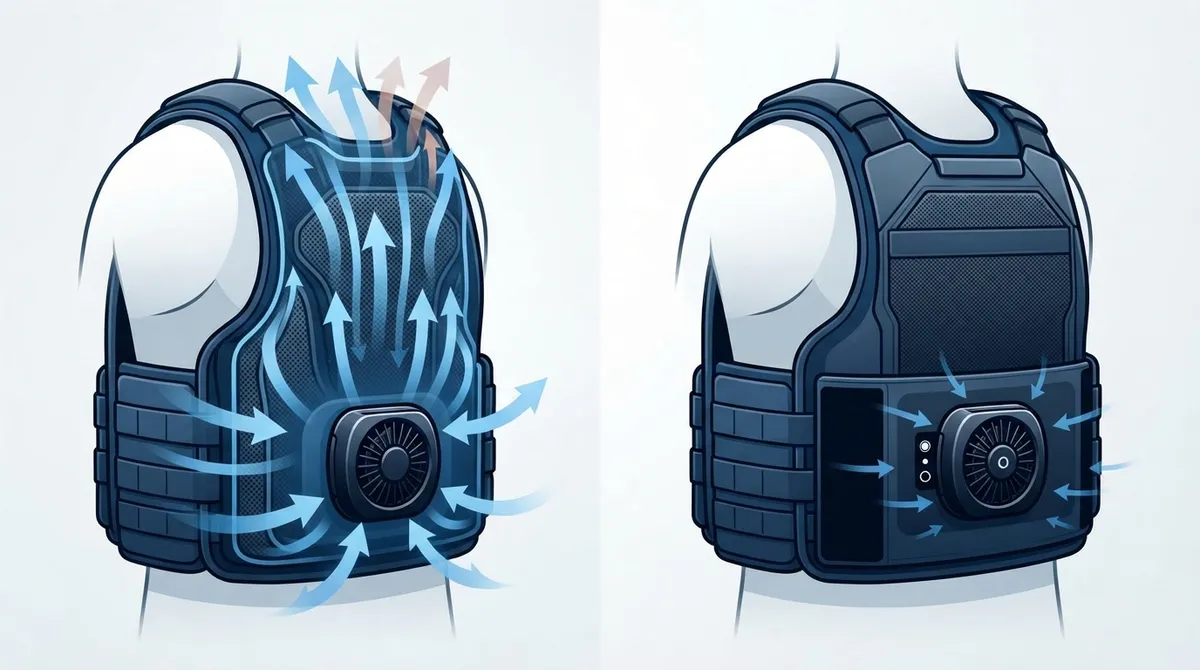
A body armor fan is a small, battery-powered unit that moves air beneath your vest. It does not make cold air. Instead, it pushes fresh air across your skin so sweat can evaporate. That is called evaporative cooling, and it is the same reason a breeze feels nice on a hot day.
Some fans are built into a garment. Others are separate units that slide under your existing armor and direct air where you need it. If you want to dig deeper into the basics, our guide on what an under vest cooling fan is and whether it works is a good place to start.
Some products skip the fan entirely and use passive designs. Those have no fan-speed setting at all. If you are weighing powered against unpowered options, check out 13 facts on active vs passive body armor cooling.
Adjustable vs Fixed Speed: The Basic Difference
Here is the plain-language version:
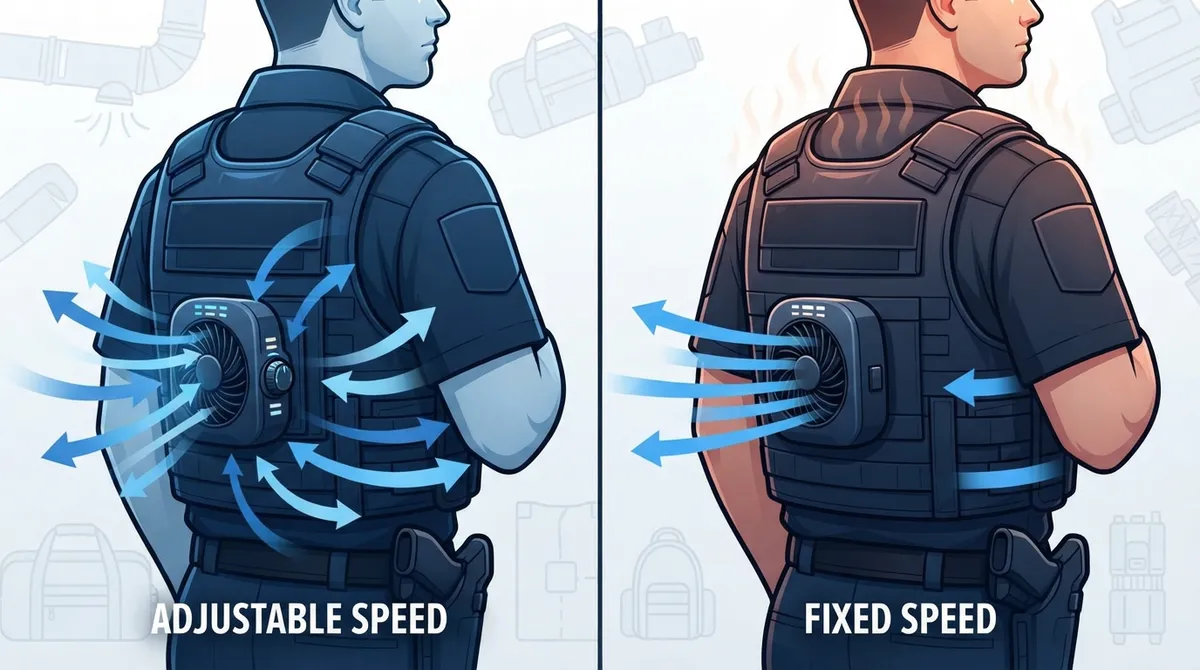
- Adjustable-speed fan: You pick the airflow level. Turn it up when it is hot and you are working hard. Turn it down when things cool off.
- Fixed-speed fan: It runs at one preset output. You turn it on and off, and that is it.
Neither type is better in every case. Real-world results depend on the fan and battery specs, how the air is routed, how well your armor fits, and the weather around you.
How Fan Speed Changes Your Cooling
Higher speeds generally move more air. More air can mean more sweat evaporation and a stronger cooling feel. But there is a trade-off. Faster fans draw more power and tend to make more noise.
Lower speeds sip power. They can stretch your battery and keep things quieter. The catch is that in very hot conditions, a low setting may not feel like much.
Think of it like the heat in your patrol car. Sometimes you want the AC on full blast. Other times a gentle breeze is plenty. An adjustable fan gives you that choice. A fixed-speed fan makes the choice for you ahead of time.
Quick Comparison Table
| Feature | Adjustable-Speed Fan | Fixed-Speed Fan |
|---|---|---|
| Airflow control | You choose the level | One preset level |
| Battery runtime | Flexible; lower settings stretch it | Set by one output level |
| Noise | Quieter on low settings | Consistent at one level |
| Ease of use | A knob or button to manage | Very simple: on or off |
| Best for | Changing conditions during a shift | Steady, predictable conditions |
Keep in mind that this table describes general design differences. A fixed-speed fan is not automatically more reliable or longer-lasting. Runtime depends on battery size, fan power, airflow resistance, and operating conditions.
When an Adjustable Fan Makes the Most Sense
Adjustable control is helpful when your day changes a lot. A patrol officer, for example, might move from a hot parking lot to a cool building, then back into a sun-baked car. One fan setting will not fit all three moments.
Here are a few situations where adjustable shines:
- Mixed duty: Foot patrol, vehicle time, and indoor stops in the same shift.
- Long shifts: You can save battery in cooler hours and use more power when the heat peaks.
- Quiet moments: Drop the speed when you need less fan noise during a stakeout or a calm conversation.
- Changing weather: Morning cool, afternoon scorcher? Adjust as you go.
Adjustable fans also help you stretch battery life. If you want to understand this better, read how fan speed affects vest cooling battery life in 2026.
When a Fixed-Speed Fan Can Be Enough
A fixed-speed fan has its own charm: simplicity. There is nothing to fiddle with. You switch it on, and it runs at one level. For some people, that is exactly what they want.
A fixed-speed design may suit you if:
- Your work conditions stay fairly steady from start to finish.
- You want gear with as few controls as possible.
- You often wear gloves or work in situations where fine adjustments are a hassle.
- You prefer a set-it-and-forget-it routine.
The main downside is flexibility. If the preset speed is too weak for a hot day, you cannot turn it up. If it is stronger than you need on a mild day, you may use more battery than necessary.
Battery Life: What the Numbers Really Mean
Runtime is one of the biggest questions people ask. The honest answer is that it varies by product and by test. Always compare the maker’s specs and note how those numbers were measured.
Here are a few examples from the market. They are product-specific and should not be treated as universal benchmarks:
- An adjustable BluFano system advertises roughly 8 hours at its highest setting, 15 to 20 hours at medium, and up to 32 hours at its lowest setting. These are manufacturer claims, not independent test results.
- INUTEQ’s AirVent Vest page describes three integrated fans and up to four hours of cooling per charge, depending on the battery chosen.
- A Makita ventilated vest listing shows four airflow settings with air-volume figures from 1.3 to 2.7 cubic meters per minute. That is a work vest, not a body armor fan, so it is not a direct benchmark.
The big lesson is that lower settings usually stretch runtime. If you want to see this laid out for one system, our BluFano battery runtime by fan setting guide breaks it down.
Noise: The Quiet Factor
Nobody wants a loud fan when they need to listen. Faster speeds usually mean more sound. An adjustable fan lets you lower the volume when it matters, while still keeping some airflow going.
A fixed-speed fan stays at the same sound level all the time. If that level is low, great. If it is high, you cannot change it. Because noise varies by design, it helps to read about the specific fan you are considering. For one example, see 9 facts on BluFano fan noise at low speed.
Why BluFano Is a Top Pick for Adjustable Control
If you want the flexibility of adjustable speed, BluFano is built for it. It is a self-contained, active airflow unit with a patented air-redirect spout that slides under any style of body armor. You can secure it with an optional strap and control the airflow with a simple knob.
It also includes a built-in 10,000mAh power bank. That power bank runs the fan and can charge your USB devices too. There is even a forward-facing light for hands-free help in low-light moments.
Officers who use it often talk about less sweat, faster cooling, and better focus on hot days. If you are curious how to dial in your settings, read how to adjust BluFano fan speed under body armor.
Pair a Fan With BluHalo for Even More Relief
A fan works best when air has room to move. That is where BluHalo comes in. BluHalo is a lightweight ventilation vest, under 7 ounces, that sits flat when deflated. When you inflate it with a small pump, it can lift your armor up to about 1.5 inches off your body and create a cooling air gap.
Together, BluHalo and BluFano give you space and moving air under your gear. BluHalo was created by a Chicago police officer who knew the problem firsthand. You can learn more in 8 steps to use BluHalo and BluFano together.
Not sure which one fits you best? This comparison can help: BluFano vs BluHalo: which cooling vest fits you. Many people choose to bundle both for maximum comfort.
How to Choose the Right Fan Speed Setup
Ready to pick? Follow these simple steps:
- Look at your shift. Is it steady or full of changes? Changing conditions favor adjustable control.
- Think about noise. Do you need quiet moments? Adjustable speeds help you turn it down.
- Check battery needs. Long shifts call for settings that stretch power.
- Confirm the fit. Make sure the fan, outlet, cables, and battery work with your vest or plate carrier without blocking armor coverage or movement.
- Compare real specs. Look at manufacturer details and test methods, not just labels like adjustable or fixed.
For a deeper walk-through, see how to pick a cooling fan system for body armor.
Choosing a Fan Speed for a Long, Hot Shift
Here is a simple way to think about speed during your day:
- Low: Cooler hours, indoor time, or when you want max runtime and a quiet fan.
- Medium: A good middle ground for most of a warm shift.
- High: Peak heat and hard work, used in bursts so your battery lasts.
Pre-cooling helps too. Some officers run vehicle air conditioning while using the fan to boost the effect. For more ideas, check out 10 tips for wearing body armor comfortably in heat.
Humidity and Real-World Limits
Fan cooling relies on sweat evaporating. In very humid weather, sweat does not dry as easily, so the effect can feel weaker. Heat, humidity, clothing, and fit all play a part.
That does not mean a fan is useless in humid places. It still moves air and helps reduce that stuck, soggy feeling. Just keep your expectations realistic and use other comfort steps too. Our piece on how to improve airflow under body armor offers extra tips.
A Fan Is a Comfort Tool, Not a Safety Plan
This part matters. A ventilation fan helps with comfort. It does not replace a real heat-stress plan. Water, rest breaks, getting used to hot conditions, and following your employer’s rules all still count. You can read the official guidance on the OSHA heat stress guide.
Also remember that armor safety comes first. Any cooling add-on should never block coverage or limit your movement. For background on armor itself, see these body armor standards from the National Institute of Justice. To understand the bigger picture of heat risk, read heat stress vs heat illness: what officers must know.
Which Type Fits Which Role?
| Role | Typical Conditions | Likely Better Fit |
|---|---|---|
| Patrol officer | Mixed: car, foot, indoors | Adjustable |
| Military personnel | Long, hot missions | Adjustable for runtime control |
| Security guard | Long stationary hours | Either; adjustable for flexibility |
| Tactical/SWAT | High intensity, varied | Adjustable |
| Emergency responder | Extreme heat, quick changes | Adjustable |
This is a general guide, not a rule. Your comfort needs and your gear setup matter most.
Final Thoughts
When it comes to adjustable vs fixed speed body armor fans, adjustable models give you control over airflow, runtime, and noise. Fixed-speed fans offer simplicity. Neither wins every time, but if your day changes often, adjustable control tends to be the friendlier choice.
For a ventilation setup you can tune to your shift, explore BluFano and BluHalo, either alone or bundled for extra savings. Have questions about fit or which option suits your gear? Please reach out to the BluHalo team and we will help you find your best match. Stay cool and stay safe out there.
FAQs
Q: What is the difference between adjustable-speed and fixed-speed fans in a ventilation vest?
A: An adjustable-speed fan lets you pick how much air it moves, so you can raise or lower it as the day changes. A fixed-speed fan runs at one preset level. Some vests skip the fan entirely and use passive ventilation, which has no speed setting.
Q: Does a higher fan speed cool you more under body armor?
A: Usually, yes. Higher speeds move more air, which can boost sweat evaporation and cooling. The trade-off is more battery use and more fan noise, so many people save high speed for the hottest moments.
Q: How much longer does a ventilation vest battery last on low speed?
A: It depends on the product, but lower settings generally stretch runtime a lot. For example, one adjustable system advertises about 8 hours on high and up to 32 hours on low. Those numbers are manufacturer claims for that product, so check the specs of any fan you consider.
Q: Can a ventilation fan prevent heat illness?
A: No. A fan is a comfort aid, not a replacement for hydration, rest breaks, acclimatization, and your employer’s heat-safety rules. Use it alongside a solid heat-stress plan, and follow guidance from sources like OSHA.
Q: Can a ventilation fan fit under my existing plate carrier or body armor?
A: Many can, but fit varies by product. Make sure the fan, outlet, cables, and battery sit comfortably without blocking armor coverage or limiting movement. A system like BluFano is designed to slide under many armor styles with its air-redirect spout.