Key Takeaways
-
Standalone battery fan vests offer full freedom of movement with no hose to snag, making them the better fit for patrol, tactical, and other mobile body-armor work.
-
Fan vests move air but do not chill it; OSHA notes airflow cooling is generally effective only when air is cooler than your skin, typically below about 95°F dry-bulb.
-
Hose cooling systems can use large amounts of compressed air (one brand lists 25-35 SCFM at 100 psig), so you need a reliable compressor or plant air supply to keep cooling consistent.
-
Chilled vortex-tube hose systems can cool more deeply than plain airflow, but that benefit comes with tethering and air supply requirements, suiting fixed stations better than moving work.
-
A hose-fed cooling vest is not a respirator; cooling air should never be treated as breathable air unless the system is specifically designed, approved, and used for respiratory protection.
-
Cooling gear is only one tool: hydration, rest breaks, and heat-illness monitoring remain essential, since protective gear can raise heat illness risk regardless of the cooling system used.
If you wear body armor all day, you know the feeling. Your shirt is soaked, your back is hot, and your focus starts to slip. You start looking for a fix, and two options keep popping up: a standalone vest fan and a hose cooling system. They sound similar, but they work in very different ways.
So which one is right for you? The honest answer depends on your job, your gear, and where you work. A standalone vest fan vs hose cooling system comparison comes down to freedom of movement, air supply, and real-world safety. In this guide, we break down the three biggest differences in plain language. We also share what OSHA says about airflow cooling, so you get facts, not hype. Whether you patrol a beat, guard a site, or respond to emergencies, you will leave with a clear plan. Let’s cool things down.
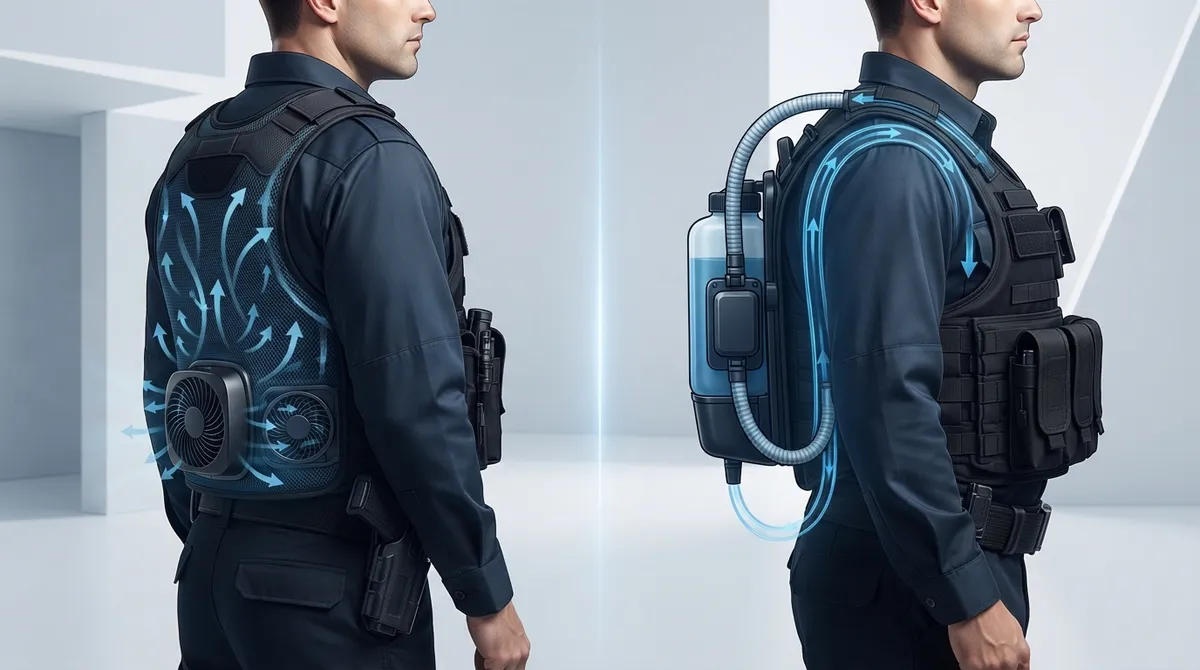
First, What Do These Two Systems Actually Do?
Before we compare, let’s make sure we are talking about the same thing. These two terms get mixed up a lot.
The Standalone Vest Fan
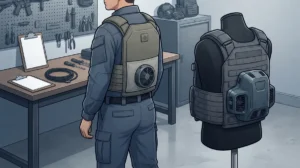
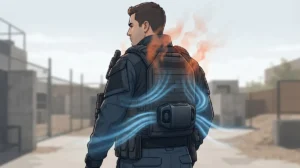
A standalone vest fan is a battery-powered unit that moves the air around you. It pulls ambient air and pushes it under your vest or armor. It does not make the air colder. It simply keeps air moving so heat and sweat can leave your body.
Because it runs on a battery, there is no cord to a wall or a compressor. You wear it, turn it on, and go.
The Hose Cooling System
A hose cooling system gets its air from an outside source, usually compressed air. A hose connects your vest to that supply. Some systems use a vortex tube to chill the incoming air before it flows through a perforated vest. Others just circulate compressed air without any chilling step.
These are not all the same. A chilled system and a simple air-flow system can perform very differently.
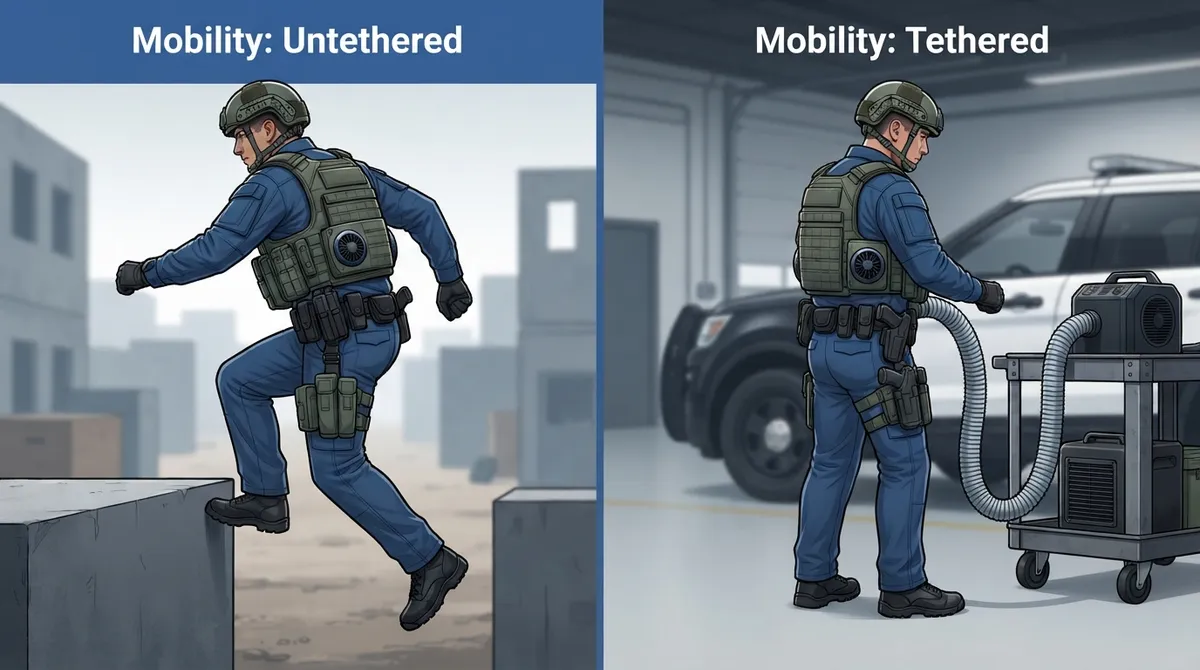
1. Mobility: Untethered vs. Tethered
This is the biggest difference, and it matters most for people who move for a living.
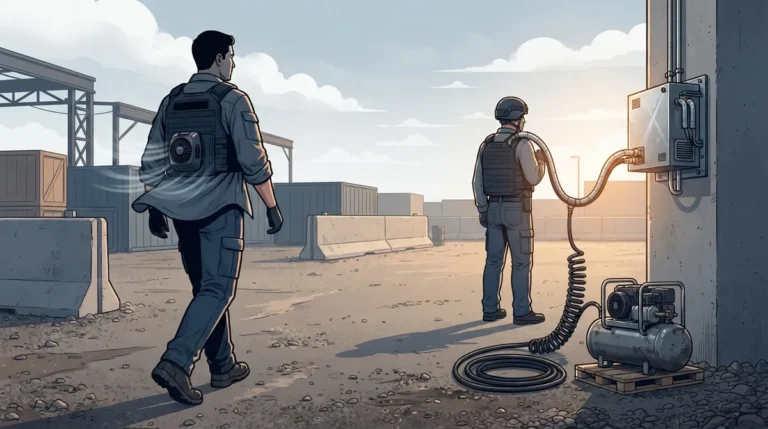
A standalone vest fan has no hose. You can run, climb, drive, and kneel without dragging anything behind you. For patrol officers, tactical teams, and soldiers, that freedom is a big deal.
A hose system ties you to an air source. That can work well in a fixed spot, like a foundry floor or a workshop. But it is a poor match for work that changes by the minute.
Quick Look: Mobility Compared
| Feature | Standalone Vest Fan | Hose Cooling System |
|---|---|---|
| Power source | Built-in battery | External compressed air |
| Movement | Fully free | Limited by hose length |
| Setup time | Seconds | Requires connection to supply |
| Best for | Mobile, changing work | Fixed, stationary work |
| Trip or snag risk | Low | Higher |
Think about a foot pursuit or a quick room entry. A hose is the last thing you want attached to you. For mobile duty, the standalone approach wins on freedom alone.
2. Air Supply and Power: Battery vs. Compressed Air
The second big difference is where the air and the power come from.
How Long Does a Battery Last?
A fan vest runs for as long as its battery allows. Runtime depends on the fan speed you choose. Lower speeds last longer, and higher speeds drain faster. A good unit gives you a full shift on a low setting. If you want to learn how settings change runtime, our guide on how fan speed affects vest cooling battery life in 2026 covers it well.
The Blufano is built for this exact need. It runs on a built-in 10,000mAh power bank and delivers adjustable airflow for 8 to 32 hours, depending on the setting. It also charges USB devices and has a forward-facing light. You can read more in our BluFano battery runtime by fan setting guide.
How Much Air Do Hose Systems Need?
Hose systems can use a lot of compressed air. One manufacturer lists 25 SCFM for its smaller vest and 35 SCFM for larger models at 100 psig. That is roughly 708 to 991 standard liters per minute. These numbers are for one brand, and other products will differ.
That kind of demand means you need a compressor or plant air line that can keep up. If the supply drops, so does your cooling.
- Battery fan: Charge it, wear it, and go. No shared infrastructure.
- Hose system: Needs a suitable compressed-air source, hoses, and fittings.
- Battery fan: Runtime is limited by the battery, but you can carry a spare or recharge.
- Hose system: Airflow can run non-stop as long as the supply holds.
The hose system does have one real advantage here. If your site already has plenty of compressed air, the flow never runs out. A battery does eventually need a charge.
3. Cooling Power and Safety: What Each System Can and Cannot Do
This is where honest talk matters. Neither option is magic, and each has limits you should know.
Fans Move Air. They Do Not Chill It.
A standalone fan vest does not refrigerate the air. Its cooling comes from airflow helping heat leave your body, mostly through evaporation of sweat. According to the OSHA Heat Stress Guide, moving air improves heat exchange, but fan cooling is generally effective only when the air is cooler than your skin. That is usually below about 95°F dry-bulb. Airflow does not lower the room or outdoor temperature.
This means a fan vest shines in the very conditions most officers face: hot, sweaty, but under that 95°F line. If you want to understand the science, check out how an airflow system for military vests actually works.
Chilled Hose Systems Can Cool Deeper
A vortex-tube hose system can chill incoming air. One manufacturer lists cooling capacities of 1,500 or 2,500 BTU/hr for its vortex-tube vests. Those are product-specific figures, not an industry standard. Still, chilled air can help in hotter settings where plain airflow falls short.
The trade-off is that you give up mobility and take on air supply needs. For a worker standing in one hot spot all day, that can be worth it.
An Important Safety Note
A hose-fed cooling vest is not automatically a respirator. Cooling air should not be treated as breathable protective air. Only a system specifically designed, approved, and used for respiratory protection should ever be used that way. Never assume your cooling hose doubles as a breathing supply.
Which One Fits Your Job?
Let’s make this practical. Here is how the choice often plays out for different roles.
- Patrol and law enforcement: You move in and out of the car all shift. A standalone fan wins because there is no hose to manage.
- Military and field work: You carry gear for long hours with no fixed power source. Battery-powered airflow makes more sense.
- Tactical and SWAT teams: Speed and freedom come first. A hose would be a hazard during dynamic entries.
- Security professionals: You stand, walk, and drive across varied sites. A battery fan fits that rhythm.
- Industrial and fixed-station work: If you stay in one place and have plant air, a hose system can be a fair choice.
For nearly every body-armor wearer on the move, the standalone option is the more practical pick. It pairs well with the way you already work. You can explore the broader field in our roundup of bulletproof vest cooling solutions ranked for 2026.
Why BluHalo and Blufano Lead the Standalone Category
If you want standalone cooling that works under real armor, BluHalo and Blufano are built for the job. They were designed by someone who lived the problem, a Chicago police officer who was tired of overheating on duty.
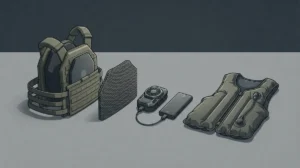
The BluHalo is a lightweight ventilation vest weighing under 7 ounces. It sits flat when deflated and lifts your armor up to about 1.5 inches off your body when inflated. That gap lets air move and heat escape. You inflate it with a small pump and release it with a button. Learn the basics in how to inflate and deflate BluHalo.
The Blufano is the active side of the pair. Its air-redirect spout slides under any style of body armor, and an optional strap holds it in place. Together, they give you an air gap and moving air at the same time. Not sure which to pick? Our BluFano vs BluHalo comparison breaks it down.
- No hose and no compressor: Wear it anywhere, anytime.
- Fits under body armor: Low profile and quiet.
- Long runtime: Up to 32 hours on a low setting with Blufano.
- Bundle and save: Use both together for stronger cooling.
Customers report staying cooler, drier, and sharper on long, hot shifts. For more on how heat hits your mind and body, see how heat affects police reaction time on duty.
Do Not Skip the Basics of Heat Safety
Here is a friendly reminder. Neither vest replaces a real heat-illness prevention plan. OSHA notes that workload, humidity, radiant heat, clothing, acclimatization, hydration, rest, and monitoring all play a role. Some protective gear can even raise your risk of heat illness.
Use your cooling gear as one tool in a bigger toolbox. Drink water, take breaks when you can, and watch for signs of trouble. You can read more about the risks in our piece on heat stress vs. heat illness. For armor standards and safety guidance, the National Institute of Justice body armor standards are a trusted source.
If you create content in this space and want help reaching the right readers, teams like SEO Rocket can help you grow your reach online.
The Bottom Line
When you weigh a standalone vest fan vs hose cooling system, the choice usually comes down to how you work. If you move, drive, and respond, a battery-powered fan keeps you free and cool. If you stay in one hot spot with plenty of compressed air, a hose system can make sense. Just remember that a hose cooling vest is not a respirator.
For most body-armor wearers, a standalone setup with BluHalo and Blufano is the smarter, simpler way to beat the heat. Ready to feel the difference on your next shift? Contact our team and we will help you find the right cooling setup for your gear.
FAQs
Q: How does a battery-powered fan vest work?
A: A battery-powered fan vest uses small fans to move the air around you under your vest or armor. It does not chill the air. Instead, it helps sweat evaporate and lets trapped heat escape so you feel cooler.
Q: Can a fan vest cool me when the air temperature is above 95°F?
A: Usually not very well. OSHA notes that airflow cooling is generally effective only when the air is cooler than your skin, typically below about 95°F dry-bulb. Above that, moving air may not help much, so rest, water, and other heat controls matter even more.
Q: How much compressed air does a hose cooling vest need?
A: It depends on the product. One manufacturer lists 25 SCFM for its smaller vest and 35 SCFM for larger models at 100 psig. Always check the exact specs for your system and make sure your air supply can keep up.
Q: Can a compressed-air cooling vest be used as respiratory protection?
A: No, not unless the full system is specifically designed, approved, and used for breathing protection. A cooling vest is not automatically a respirator. Never treat cooling air as breathable air without proper approval.
Q: Which is better for patrol work: a fan vest or a hose-fed cooling vest?
A: For patrol, tactical, and other mobile work, a standalone fan vest is usually the better fit. It has no hose, so you can move, drive, and respond freely. Hose systems suit fixed stations with a reliable compressed-air supply.