Key Takeaways
-
Evaporative cooling vests work best in hot, dry air; a 2026 manikin study found raising humidity from 20% to 40% at 35°C cut cooling capacity by an average of 28%.
-
A fan does not cool the air; it only moves it, and airflow helps mainly when air temperature is below skin temperature, around 95°F (35°C).
-
Check whether your outer layer and armor leave room for airflow or moisture, since a sealed layer can trap air and make a fan far less useful.
-
Any wet or damp cooling layer must not interfere with protective gear, fit, or required safety functions; confirm with your agency or safety officer first.
-
Cooling claims depend on air temperature, humidity, and fit, so treat any single product rating as a clue rather than a guarantee.
-
Cooling gear supplements, but does not replace, rest breaks, hydration, shade, acclimatization, and watching for heat illness symptoms.
Picture this: it’s a 95-degree afternoon, you’re on hour nine of a twelve-hour shift, and your body armor feels like a personal sauna. You’ve seen the ads for cooling gear, and now you’re stuck on one big question. Should you grab an evaporative cooling vest or an under vest fan?
Here’s the good news. You’re asking the right question. Here’s the not-so-good news. A lot of people pick the wrong one, or use the right one the wrong way. That wastes money and leaves you sweaty.
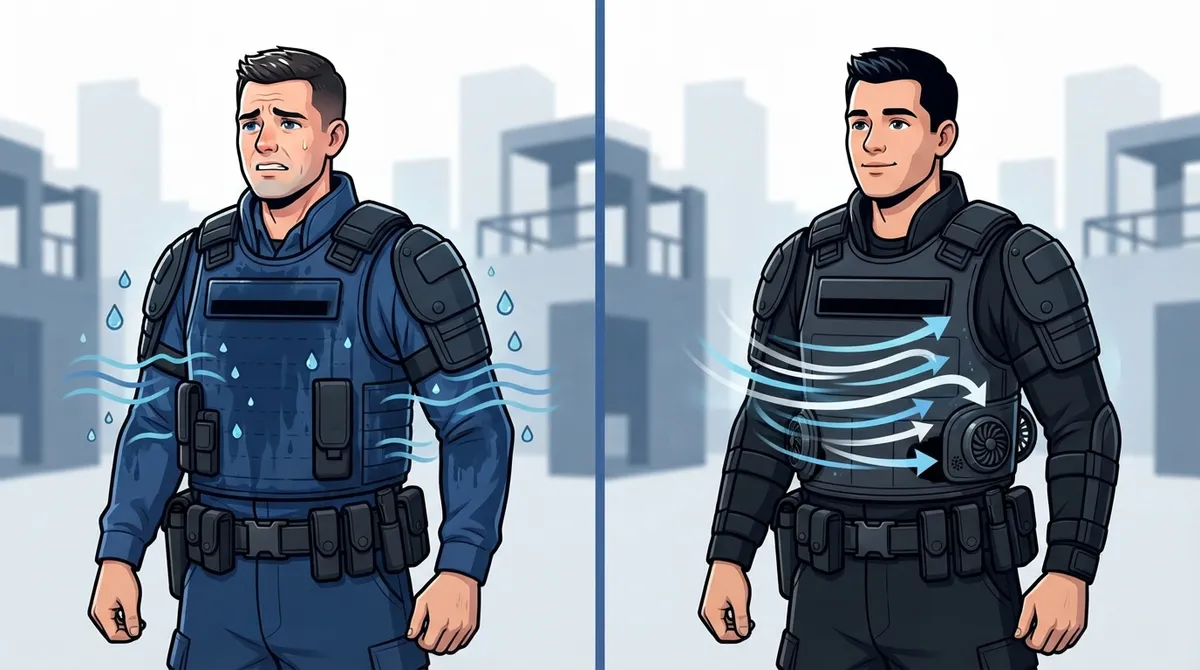
The evaporative cooling vest vs under vest fan debate comes down to how each one removes heat. One uses water. The other uses moving air. Each shines in some conditions and struggles in others. Below, we walk through 10 common mistakes so you can skip the trial and error and stay comfortable under your gear.
Evaporative Cooling Vest vs Under Vest Fan: The Quick Version
Before we get to the mistakes, let’s make sure we’re on the same page about how these two work.
An evaporative cooling vest holds water in absorbent fabric. As that water evaporates, it pulls heat away. When the water runs low, you have to wet the vest again.
An under vest fan uses a small battery-powered fan to move air beneath your outer layer. That moving air helps heat leave your body and helps sweat evaporate. It does not chill the air. It just keeps air flowing where heat likes to hide.
| Feature | Evaporative Cooling Vest | Under Vest Fan |
|---|---|---|
| How it cools | Water evaporates and removes heat | Moving air carries heat and moisture away |
| Best conditions | Hot, dry air | Wider range, if air is cooler than skin |
| What you maintain | Rewetting the vest | Charging or swapping batteries |
| Weak spot | High humidity | Very hot air, blocked airflow paths |
| Works under armor? | Depends on fit and moisture | Depends on airflow path |

The 10 Mistakes That Cost You Comfort
1. Ignoring Humidity When You Choose
This is the biggest one. Evaporative cooling depends heavily on how dry the air is. When humidity climbs, water evaporates more slowly, and the cooling effect drops.
A 2026 thermal-manikin study published in Scientific Reports found that raising relative humidity from 20% to 40% at 35°C reduced evaporative-vest cooling capacity by an average of 28%. That was a controlled lab test, not a promise for every product. But it shows how much humidity matters.
If you work in a sticky, humid area, an evaporative vest alone may disappoint you. Check your local climate before you buy.
2. Assuming a Fan Cools the Air
A fan does not make cold air. It moves the air that’s already there. That’s a big difference.
The OSHA Heat Stress Guide explains that air movement generally helps cooling only when the air temperature is below skin temperature, usually about 95°F (35°C). If the air is hotter than that, moving it can actually add heat instead of removing it.
So if you’re working in a scorching parking lot with no shade, a fan is not a magic fix. Pair it with shade, rest, and water.
3. Forgetting That Your Outer Layer Matters
Your fan can only do its job if air can actually flow. A thick, sealed outer layer can trap that air and make the fan far less useful.
Before you commit, think about the whole system: your base layer, your armor, and your outer carrier. Learn more about how vest fit affects cooling airflow under body armor so you set things up right the first time.
4. Soaking Your Vest Under Armor Without a Plan
Wearing a wet evaporative vest under body armor sounds simple. In real life, it gets tricky. Moisture trapped against your armor can feel clammy, and it may add to odor and wear over time.
Always check that any wet or damp layer does not interfere with your protective gear, your fit, or your required safety functions. If you’re unsure, read up on how to stop body armor from smelling like sweat before you add water into the mix.
5. Treating the Two Options as Rivals Only
Here’s a fun twist. You don’t always have to choose. Airflow can help an evaporative vest work better because it speeds up evaporation. Some products even combine fans with wetted or other cooling layers.
So the real question may not be “which one wins?” It may be “which one fits my job, my climate, and my gear?” If you’re comparing options, our guide on evaporative vests vs. ventilation vests breaks it down further.
6. Trusting a Single Number From a Product Page
Cooling claims can look impressive. But results depend on air temperature, humidity, fit, and design.
In a 2026 hot, dry chamber study, a fan-assisted evaporative vest reached a mean cooling capacity of 83 ± 8 W, while a microtube-based evaporative vest reached 56 ± 5 W at 20% relative humidity. At 40% humidity, those numbers dropped to 74 ± 4 W and 47 ± 4 W. Those results apply only to the tested designs and conditions.
The lesson? Treat any single rating as a clue, not a guarantee. Look for honest specs and real-world reviews.
7. Guessing at Battery Life
There’s no reliable, category-wide number for how long under vest fan batteries last. Runtime changes with battery size, fan speed, and how you use the device.
Always use the manufacturer’s tested specs. For example, BluFano is designed to deliver adjustable airflow for roughly 8 to 32 hours depending on the setting, with a built-in 10,000mAh power bank. You can dig deeper in our BluFano battery runtime guide.
8. Overlooking Weight, Noise, and Upkeep
Cooling is only part of the story. Think about how the gear feels on a long day.
- Weight: Heavy, water-filled vests can feel burdensome over a full shift.
- Noise: Loud fans can be distracting, especially in quiet or tactical settings.
- Upkeep: Evaporative vests need rewetting. Fans need charging.
- Cleaning: Damp fabric needs proper drying and care.
- Access: Do you have water or power available during your shift?
If your day is long and unpredictable, simple and low-maintenance usually wins.
9. Skipping the Compatibility Check With Your PPE
This one matters most for firefighters, hazmat teams, and tactical units. Any cooling garment must not compromise required protective clothing, fit, or safety functions.
Check with your agency or safety officer first. The CDC’s NIOSH also notes that protective gear adds a real heat burden, so planning matters. For armor standards, visit the Body Armor Standards page from the National Institute of Justice.
10. Believing Any Vest Replaces Heat Safety
No cooling vest or fan replaces a real heat-safety plan. Rest breaks, hydration, shade or cooler areas, acclimatization, and watching for signs of heat illness all still count.
Gear helps you feel better and stay sharper. It does not make you immune. Read about heat stress vs. heat illness so you know the warning signs.
How to Choose: A Simple 5-Step Check
Not sure where to land? Walk through these steps in order.
- Check your climate. Hot and dry leans toward evaporative. Humid leans toward airflow.
- Check the air temperature. If it’s often above 95°F, remember that moving air may not cool you much.
- Check your gear. Make sure your armor and outer layers leave room for airflow or moisture.
- Check your access. Will you have water to rewet, or power to recharge?
- Check your job demands. Think about movement, noise, weight, and how long your shifts run.
Where BluHalo and BluFano Fit In
Many people who wear body armor need more than a damp vest or a basic fan. They need space and airflow where heat gets trapped.
That’s why BluHalo was built. It was created by a Chicago police officer and weighs under 7 ounces. When inflated, it can lift the vest up to about 1.5 inches off your body, creating a cooling air gap. When you don’t need it, a button deflates it so it lies flat. It’s a smart way to get cooling on demand.
Pair it with BluFano, and you get active airflow too. BluFano slides under any style of body armor through a patented air-redirect spout, and it includes a 10,000mAh power bank plus a forward-facing light. Together, they tackle heat, sweat, and stagnant air as a team. You can learn more in our guide on using BluHalo and BluFano together, or see which one fits you best.
Which Option Fits Your Role?
| Role | Main Challenge | What to Consider |
|---|---|---|
| Patrol officers | Long shifts in armor | Airflow and an air gap under the vest |
| Military personnel | Heavy gear, high heat | Durable, low-maintenance cooling |
| Security professionals | Extended standing, varied climates | Quiet, steady airflow |
| Tactical/SWAT teams | High intensity, heavy armor | Fast, reliable airflow without bulk |
| Emergency responders | Extreme heat, protective gear | PPE compatibility and safety checks |
For more ideas, check out our roundup of the best under body armor cooling solutions and our guide on how to stop overheating under body armor on duty.
Wrapping It Up
So, who wins the evaporative cooling vest vs under vest fan showdown? It depends on your climate, your gear, and your job. Evaporative vests shine in dry heat. Fans give you airflow across more conditions, as long as the air is cooler than your skin and your outer layer lets it move. And you can often combine the two ideas for better results.
Avoid the 10 mistakes above, and you’re already ahead of most buyers. Keep your heat-safety habits strong, and pick gear that fits your real day, not just a spec sheet.
Ready to feel cooler under your armor? Contact the BluHalo team and we’ll help you find the right setup for your shift.
FAQs
Q: Is an evaporative cooling vest or an under vest fan better for hot-weather work?
A: It depends on your conditions. Evaporative vests tend to work best in hot, dry air, while fans can help across a wider range as long as the air is cooler than your skin. Your gear, humidity, and job demands should guide the choice.
Q: Do under vest fans work in high humidity?
A: They can still help, because moving air supports heat exchange and sweat evaporation beneath your clothing. Just keep in mind that very humid air limits how much sweat can evaporate, so results vary. Good airflow paths and a breathable outer layer make a big difference.
Q: Can a fan be used with an evaporative cooling vest?
A: Yes, and it often helps. Airflow speeds up evaporation, which can boost the cooling effect of a wetted vest. Some products even combine fans with wetted or other cooling layers, but always check that the setup fits with your protective gear.
Q: How long does a fan battery last compared to how long an evaporative vest stays cool?
A: Both vary a lot by product and conditions. Evaporative vests stay cool until their stored water runs low, then need rewetting. Fan runtime depends on battery size and fan setting, so rely on the maker’s tested specs. BluFano, for example, is built for roughly 8 to 32 hours depending on the setting.
Q: Do cooling vests and fan garments replace workplace heat-safety measures?
A: No, they work best alongside them. Rest breaks, hydration, shade or cooler areas, acclimatization, and watching for heat illness symptoms are still essential. Think of cooling gear as a helpful boost, not a replacement for a full heat-safety plan.