Key Takeaways
-
Body armor traps heat against your torso, reducing sweat evaporation and increasing core temperature, physical workload, and perceived exertion—even before heat-illness levels are reached, according to 2017 research.
-
Active fan-driven airflow systems provide roughly double the cooling capacity (331 Wh/m²) of evaporative vests (113 Wh/m²) over eight hours, making them more effective for long shifts and humid conditions.
-
Personal ventilation systems can reduce core temperature by 0.26-0.34°C and lower physiological strain index scores by 9-21%, creating a critical buffer that delays fatigue and heat-related illness onset.
-
OSHA recommends a 7-14 day staged acclimatization process starting at 50% workload for officers new to hot conditions, with similar shorter adjustments needed for those returning after three or more days off.
-
Effective heat-stress prevention requires a layered approach combining ventilation vests with hydration, work-rest cycles, shaded recovery areas, and clear procedures for removing officers from duty when symptoms appear.
-
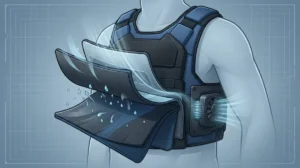
Ventilation vests designed with air-gap technology (like BluHalo) can lift armor 1.5 inches off the body to enable heat escape while maintaining ballistic protection, offering on-demand cooling without battery requirements.
If you wear a duty belt and body armor every shift, you already know the feeling. Your vest traps heat, sweat pools against your skin, and by hour six you’re fighting fatigue instead of focusing on the job. This isn’t just discomfort. It’s heat stress in law enforcement, and it’s a real safety issue that deserves real attention. The good news? You have more control over it than you might think.
In this article, we’ll break down why body armor makes heat stress worse, what the research actually says, and how cooling gear like ventilation vests fits into a smart, layered prevention plan. Whether you’re a patrol officer, a SWAT operator, or a security professional standing post in the sun, this guide is for you. Let’s get into it.

What Is Heat Stress in Law Enforcement, Really?
Heat stress happens when your body takes in more heat than it can release. For officers, this usually comes from a mix of hot weather, physical exertion, and gear that traps heat against the skin. Body armor, load-bearing vests, helmets, and other PPE all play a part.
Unlike a construction worker who might roll up their sleeves, you can’t just take off your vest mid-shift. That’s what makes this challenge unique to law enforcement and other uniformed professionals. Your protective gear is essential, but it also works against your body’s natural cooling system.
Why Body Armor Makes Heat Stress Worse
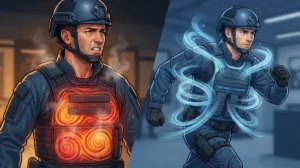
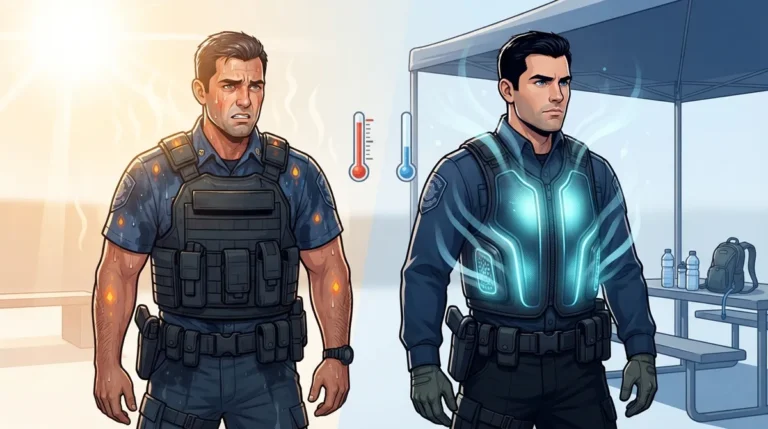
Body armor covers your torso, which is one of the biggest heat-releasing areas on your body. When that area is sealed off, sweat can’t evaporate properly, and heat gets trapped close to your skin. A 2017 systematic review found that body armor increases physiological workload, perceived exertion, and core temperature, while reducing balance and stability (source: PMC5434519). That’s not just uncomfortable. It can affect how quickly and safely you respond in the field.
The review also noted that researchers recommend special caution during high heat and humidity, even though core temperatures didn’t always reach clinical heat-illness levels in the studies. In other words, the risk is real even before things become an emergency. If you want to dig deeper into how armor affects your body, our article on heat stress effects on police performance covers this in more detail.
High-Risk Situations Officers Face
Some duties put officers at higher risk than others. Knowing when to be extra cautious can help you plan ahead and protect yourself.
- Foot pursuits and physical arrests in full gear
- Crowd control and extended outdoor events
- Traffic duty under direct sun for hours
- Tactical operations and SWAT callouts
- Firearms training in hot weather
- CBRN incidents requiring extra protective layers
A study on law enforcement personnel wearing CBRN gear in hot-dry and hot-humid conditions predicted core temperatures above 38.5°C in some scenarios. That’s a serious heat strain warning sign, especially for tactical teams operating in full protective ensembles (source: PMC4060587).

Ventilation Vests vs. Traditional Cooling Methods: Which Wins?
When it comes to managing heat under armor, officers usually have a few options. Let’s compare them so you can see where ventilation vests fit into the bigger picture.
| Cooling Method | How It Works | Best For | Limitations |
|---|---|---|---|
| Ventilation Vests | Creates an air gap and boosts airflow under armor | Daily patrol, long shifts, all climates | Needs a compatible vest fit |
| Evaporative Cooling Vests | Uses wetted fabric that cools through evaporation | Dry, low-humidity environments | Performs poorly in high humidity |
| PCM (Phase Change) Vests | Uses cooling packs that absorb body heat | Short bursts of intense activity | Can become insulating once warmed up |
| Active Fan Systems | Battery-powered fans circulate fresh air | Extended shifts, tactical use | Requires charging or battery swaps |
According to a commercial cooling-vest comparison summarized in 2026, active cooling vests offered roughly 331 Wh/m² of cooling capacity over eight hours, compared to about 164 Wh/m² for PCM vests, 146 Wh/m² for hybrid vests, and 113 Wh/m² for evaporative vests. These numbers depend on test conditions and fit, but they show why active airflow solutions often outperform passive options during long shifts.
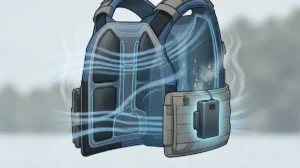
This is exactly where products like the BluHalo ventilation vest shine. Instead of relying on wet fabric or melting cooling packs, BluHalo lifts your armor up to 1.5 inches off your body when inflated, creating a real air gap for sweat and heat to escape. It weighs under 7 ounces and lies flat when deflated, so it won’t get in your way during regular duty.
How Ventilation Vests Reduce Heat Strain
Research summarized in recent studies found that personal ventilation reduced rectal-temperature rise by about 0.26°C in hot-dry conditions and 0.34°C in hot-humid conditions after roughly 100 minutes of activity. Mean skin temperature dropped by about 0.9°C and 0.6°C in those same conditions. Physiological strain index scores also dropped by 9% to 21%, depending on the environment.
These numbers matter because even small reductions in core and skin temperature can delay the onset of fatigue and exertional heat illness. That extra buffer could mean the difference between finishing a tough call strong or hitting a wall halfway through.
BluHalo: Cooling-On-Demand for Daily Duty
BluHalo was created by a Chicago police officer who understood the problem firsthand. It attaches to a clean vest with Velcro, inflates with a small pump when you need airflow, and deflates instantly with the push of a button. Officers have used it during 12-hour shifts in 95-degree heat and reported real comfort improvements. You can read more about how it works on our BluHalo usage guide.
Blufano: Active Airflow for Extended Shifts
For officers who want continuous, fan-driven airflow, Blufano is our advanced option. It’s a self-contained unit with a patented air-redirect spout that slides under any style of body armor. It runs 8 to 32 hours depending on the fan setting, and it includes a built-in 10,000mAh power bank that can also charge your phone or radio. Many users combine both products for maximum cooling coverage, especially during tactical operations or long outdoor assignments.
Choosing the Right Cooling Vest for Your Climate
Not every cooling solution works everywhere. OSHA cautions that some cooling vests can become insulating once they reach body temperature, and evaporative systems often struggle in high humidity. That’s why matching your gear to your environment is so important.
- Check your local humidity levels before choosing an evaporative system
- Consider mission duration and whether you need 8, 16, or 32 hours of airflow
- Make sure the vest is compatible with your specific armor carrier
- Factor in weight, mobility, and equipment access needs
- Ask whether the vest interferes with ballistic protection in any way
- Think about battery or water requirements for your shift length
For a deeper breakdown of features to evaluate, check out our guide on choosing the right body armor ventilation vest in 2026.
Building a Complete Heat-Stress Prevention Plan
A ventilation vest is a powerful tool, but it’s not a magic fix on its own. NIOSH recognizes cooling vests, air-cooled garments, and wetted overgarments as personal cooling systems, but recommends they work alongside other prevention strategies. Departments and individual officers should build a layered approach.
- Hydration before, during, and after shifts
- Acclimatization periods for new or returning officers
- Scheduled work-rest cycles during extreme heat
- Shaded or air-conditioned recovery areas
- Training to recognize heat exhaustion and heat stroke symptoms
- Clear procedures for pulling an officer off duty when needed
OSHA recommends a staged acclimatization process over 7 to 14 days for new workers in hot conditions, starting at about 50% of normal workload and building up gradually. Officers returning after three or more days off may need a similar, shorter adjustment period. You can learn more directly from the OSHA Heat Stress Guide, which offers detailed guidance for agencies building their own heat safety programs.
Recognizing the Warning Signs
Every officer and supervisor should know the difference between normal fatigue and a heat emergency. Heat exhaustion often shows up as heavy sweating, weakness, dizziness, and nausea. Heat stroke is more serious and can include confusion, hot dry skin, and a rapid pulse. If you or a partner notice these signs, treat it as an emergency and get medical help right away.
For a full rundown of prevention strategies tailored to officers, our post on how to prevent heat stress while wearing body armor is a great next read.
Ventilation Vests Across Different Roles
Heat stress doesn’t just affect patrol officers. It touches nearly every professional who wears protective gear in the field.
- Military personnel operating in hot climates while wearing tactical body armor for extended missions
- Security professionals standing post for hours in varying weather conditions
- SWAT and tactical teams carrying heavy armor during high-intensity operations
- Emergency responders like firefighters and hazmat teams working in extreme heat
Body armor standards, as outlined by the National Institute of Justice, are built around protection first. That means the responsibility for managing heat often falls on the additional gear worn underneath, which is exactly the gap ventilation vests are designed to fill.
Quick Comparison: BluHalo vs. Blufano
| Feature | BluHalo | Blufano |
|---|---|---|
| Type | Inflatable air-gap vest | Active fan-driven airflow system |
| Weight | Under 7 ounces | Slightly heavier due to fan and battery |
| Runtime | On-demand, instant inflate/deflate | 8 to 32 hours depending on setting |
| Extra Features | Low-profile, flat when deflated | 10,000mAh power bank, built-in light |
| Best For | Quick comfort boosts during shifts | Continuous cooling on long assignments |
Many officers choose to bundle both for maximum comfort. You can compare features side by side on our BluFano vs BluHalo comparison page.
Final Thoughts: Stay Cool, Stay Sharp
Heat stress in law enforcement is a serious issue, but it’s one you can manage with the right combination of gear, training, and awareness. Body armor will always trap some heat. That’s simply the nature of protective equipment. But a well-designed ventilation vest, paired with smart hydration and rest habits, can make a real difference in how you feel and perform on shift.
You put in the work to protect your community every day. It only makes sense to protect yourself too. If you’re ready to see how a ventilation vest can fit into your daily gear, reach out to our team and we’ll help you find the right cooling solution for your climate and duty needs.
FAQs
Q: How does body armor increase heat stress in police officers?
A: Body armor covers your torso and traps heat close to your skin, which stops sweat from evaporating the way it should. Research shows this raises core temperature and physical workload, especially during long shifts or high-intensity tasks. That’s why so many officers say their vest feels like an oven by midday.
Q: Can a ventilation vest be worn under or over a police ballistic vest?
A: Most ventilation vests, including BluHalo, are designed to attach directly to your armor carrier and sit between your body and the vest. This creates an air gap that lets heat and sweat escape more easily. It’s a simple setup that fits right into your existing gear without major changes.
Q: Do cooling vests work in humid conditions?
A: It depends on the type. Evaporative vests tend to struggle in high humidity because sweat can’t evaporate as easily, while active airflow systems like Blufano keep working no matter the humidity level. If you work in a humid climate, an active fan-driven option is usually your best bet.
Q: How long can a police cooling vest provide airflow during a shift?
A: It varies by product and setting. BluHalo offers instant, on-demand inflation and deflation whenever you need a boost, while Blufano’s fan system can run anywhere from 8 to 32 hours depending on the speed you choose. Many officers use both together for all-day coverage.
Q: What are the warning signs of heat exhaustion in law enforcement personnel?
A: Watch for heavy sweating, dizziness, weakness, and nausea, which are common early signs of heat exhaustion. If someone shows confusion, hot dry skin, or a racing pulse, that could mean heat stroke, which is a medical emergency. Always treat these symptoms seriously and get help right away.