Key Takeaways
-
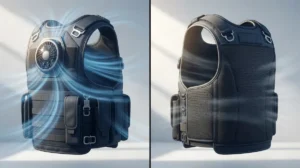
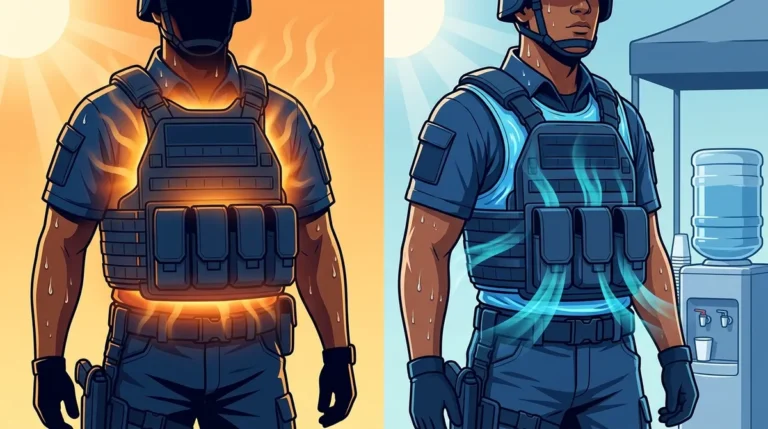
Body armor traps heat and moisture, requiring active cooling solutions; OSHA guidelines recommend monitoring heat stress when temperatures exceed 70°F during high-metabolic tasks, with core temperature kept below 100°F (38°C).
-
Ventilation vests like BluHalo and Blufano provide 20% average improvement in time to exhaustion by actively moving air under armor, offering 8-32 hours of continuous cooling versus temporary relief from basic gear.
-
Layer cooling strategies together: maintain consistent hydration (8oz every 15-20 minutes), take regular rest breaks in cool areas, gradually acclimatize over 1-2 weeks, then add a ventilation vest for maximum protection.
-
BluHalo (under 7 ounces, on-demand inflation) suits lightweight daily use, while Blufano fan system (8-32 hour battery, built-in power bank) better serves extended shifts requiring maximum continuous airflow.
-
Heat exhaustion symptoms—heavy sweating, weakness, dizziness, nausea—require immediate action as untreated exhaustion can escalate to life-threatening heatstroke with core temperatures above 104°F.
-
Basic cooling methods (hydration, rest breaks, towels) remain essential foundations but cannot solve the core problem of heat trapped under body armor during active duty operations.
If you wear body armor on duty, you know that feeling all too well. The heat builds up fast. Sweat soaks your undershirt. Your focus starts to slip. And before you know it, you’re running hot in more ways than one. Preventing heat exhaustion on duty is one of the most important challenges for law enforcement, military, security, and emergency response professionals in 2026. The question is: does basic cooling gear cut it, or do you need a smarter solution like a ventilation vest?
Let’s break it down in a friendly, honest way. We’ll compare standard approaches to heat management with modern ventilation vest technology — so you can make the best choice for your health, comfort, and performance on the job.

Why Heat Exhaustion Is a Real Risk Under Body Armor
Body armor traps heat. That’s just physics. When you strap on a ballistic vest, you’re essentially creating a sealed layer over your torso that blocks airflow and traps moisture. For officers and soldiers doing physically demanding work in hot weather, this is a serious problem.
According to the OSHA Heat Stress Guide, workers wearing semi-permeable or impermeable protective clothing need extra monitoring when temperatures exceed 70°F during high-metabolic tasks. That covers a lot of duty situations. OSHA also notes that airflow cooling is most effective when air temperature is below the worker’s skin temperature — usually under 95°F dry bulb. Understanding this is key to choosing the right cooling method.
For workers in armor, the risk factors stack up quickly. Restricted airflow, high physical output, and hot weather can push core body temperature dangerously high. The Mine Safety and Health Administration (MSHA) recommends keeping workers’ core temperature below 100°F (38°C). That goal is much harder to meet when you’re sealed inside layers of protective gear. Heat stress has serious effects on police performance — and it’s not just physical. It affects judgment and decision-making too.

Basic Cooling Gear vs. Ventilation Vests: A Head-to-Head Look
So what are your options? Most officers and first responders rely on a mix of hydration, rest breaks, and maybe a basic cooling towel or fan. But ventilation vests have changed the game. Here’s how the two approaches compare across the most important categories.
| Feature | Basic Cooling Gear | Ventilation Vest (e.g., BluHalo/Blufano) |
|---|---|---|
| Airflow Under Armor | None or minimal | Active airflow directly under the vest |
| Moisture Management | Absorbs sweat slowly | Actively reduces moisture buildup |
| Heat Release | Passive only | Active and continuous heat release |
| Wearability Under Armor | Often bulky or incompatible | Designed to fit under body armor |
| Duration of Cooling | Short-term (towels, ice packs) | 8–32 hours (Blufano battery life) |
| Ease of Use on Duty | Requires breaks or access to water | Continuous, hands-free cooling |
| Weight | Varies (ice packs can be heavy) | BluHalo weighs under 7 ounces |
As you can see, ventilation vests offer clear advantages for professionals in body armor. But that doesn’t mean basic gear is useless. The best approach combines both strategies — and we’ll talk about that shortly. If you’re curious about how these systems work side by side, check out this comparison of passive vs. active body armor ventilation.
What Basic Cooling Gear Gets Right
Let’s be fair to the basics. There’s real value in foundational heat prevention practices. OSHA recommends cool water and frequent small sips throughout a shift — not waiting until you’re thirsty. That’s solid advice that no piece of gear can replace.
Here are the core strategies that work regardless of what cooling gear you wear:
- Hydration: Drink cool water regularly throughout your shift. Small, frequent sips are better than large gulps.
- Acclimatization: Gradually build exposure to hot conditions over 1–2 weeks so your body adapts safely.
- Work-rest cycles: Rotate tasks and take breaks in cooler areas. MSHA recommends rest areas at around 50–60°F (10–15°C) for the hottest worksites.
- Task rotation: Spread physically demanding tasks across multiple team members to reduce individual heat load.
- Environmental controls: Use shade, fans, and air conditioning when available during rest periods.
These are your foundation. They’re non-negotiable. But here’s the honest truth: none of them solve the core problem of heat and moisture getting trapped under body armor during active duty. That’s where ventilation vests step in. Learning how to prevent heat stress while wearing body armor is essential for every professional who wears a vest.
What Ventilation Vests Do That Basic Gear Can’t
Ventilation vests are purpose-built for the exact problem body armor creates. They sit between your body and your vest, actively moving air to reduce heat and moisture right at the source. This is a fundamentally different approach — and it’s backed by research.
A study summarizing research on cooling vests found about a 20% average improvement in time to exhaustion in hot conditions. That’s meaningful when you’re working a 12-hour shift in 95-degree heat. Another study found that a microclimate cooling vest could serve as an effective adjunctive cooling method when core temperature remained within normal range — making the case that choosing the right first responder cooling equipment really does matter.
The BluHalo ventilation vest was actually created by a Chicago police officer who understood this problem firsthand. It weighs under 7 ounces, sits flat when deflated, and can lift your vest up to 1.5 inches off the body when inflated — creating a cooling air gap that lets heat escape. It’s cooling-on-demand, right where you need it most.
Then there’s the Blufano fan system, which takes things even further. It’s an active airflow unit with a patented air-redirect spout that slides under any style of body armor. It runs for 8–32 hours on a single charge depending on your fan setting, includes a built-in 10,000mAh power bank, and even has a forward-facing light for low-light situations. That’s a serious piece of duty gear.
Comparing Cooling Methods: Key Performance Factors
| Cooling Method | Best For | Limitations | Works Under Armor? |
|---|---|---|---|
| Hydration | All duty types | Doesn’t address external heat | N/A |
| Cooling Towels | Short breaks | Temporary, requires access | No |
| Ice Packs/Phase Change | High-intensity tasks | Heavy, short duration, melts | Limited |
| Fans/Misting | Rest areas | Not portable, not for armor | No |
| BluHalo Ventilation Vest | Active duty under armor | Manual inflation needed | Yes |
| Blufano Fan System | Extended shifts, all conditions | Requires charging | Yes |
The pattern is clear. Traditional cooling methods have real value but are mostly useful during breaks or from external sources. Ventilation vests are the only tools designed to work continuously under body armor during active duty. For a deeper dive, explore the comparison between ventilation and phase-change cooling vests.
Which Professionals Benefit Most from Ventilation Vests?
The short answer: anyone who wears body armor in the heat. But some roles benefit even more than others. Here’s a quick breakdown:
- Law enforcement officers: Long patrol shifts in warm climates make ventilation vests a daily necessity, not a luxury. See why law enforcement officers need a cooling vest.
- Military personnel: Extended missions in hot environments with heavy tactical gear put soldiers at serious heat risk. Choosing the right military cooling vest can be mission-critical.
- Security professionals: Armed guards and protective detail specialists often work long outdoor shifts with little shade or air conditioning.
- SWAT and tactical teams: High-intensity operations with heavy armor demand the best cooling technology available.
- Firefighters and hazmat teams: Extreme heat environments plus heavy gear make every degree of cooling relief count.
Standards for protective gear also matter here. The Body Armor Standards from the National Institute of Justice help ensure gear meets safety requirements — but comfort and thermal management under that gear is equally important for officer wellness and performance.
The Smart Approach: Layering Your Cooling Strategy
Here’s the honest takeaway: cooling vests are not a replacement for foundational heat safety practices. They’re a powerful upgrade to them. The smartest approach to preventing heat exhaustion on duty layers multiple strategies together.
Follow these steps to build a complete heat prevention plan:
- Start with hydration: Drink cool water throughout your shift. Don’t wait for thirst. Keep a water bottle accessible at all times.
- Acclimatize gradually: If you’re starting a new role or heading into a heat wave, build up your heat tolerance over 1–2 weeks with shorter exposures first.
- Use work-rest cycles: Schedule regular breaks in cooler environments. Even 10–15 minutes in air conditioning can reset your core temperature.
- Add a ventilation vest: Wear a BluHalo or Blufano under your body armor to actively manage heat and moisture throughout your shift.
- Monitor your symptoms: Know the warning signs of heat exhaustion — heavy sweating, weakness, dizziness, nausea. Act early, not late.
This layered approach is exactly what occupational safety authorities recommend. Cooling vests are classified as effective PPE for heat control, but they work best as part of a broader program — not as a standalone fix. For more expert guidance, the OSHA Heat Stress Guide is a great resource to bookmark.
Comparing BluHalo and Blufano: Which Is Right for You?
| Feature | BluHalo Ventilation Vest | Blufano Fan System |
|---|---|---|
| Type | Inflatable air-gap vest | Active fan-driven airflow unit |
| Weight | Under 7 ounces | Self-contained unit with power bank |
| Cooling Duration | On-demand inflation | 8–32 hours per charge |
| Extra Features | Low-profile, velcro attachment | 10,000mAh power bank, forward light |
| Best For | Lightweight, simple cooling on demand | Extended shifts, maximum airflow |
| Price | $60.00 | Advanced system (check site for pricing) |
| Bundle Option | Yes — bundle with Blufano for a discount | Yes — bundle with BluHalo for a discount |
Not sure which one suits your situation? Compare BluFano and BluHalo side by side to find your best match. You can also read real user reviews from officers and professionals who’ve put both products to the test in real duty conditions.
Final Verdict: Which Wins for Preventing Heat Exhaustion on Duty?
Basic cooling gear wins on accessibility and simplicity. Hydration, rest, and acclimatization are essential habits every professional should practice. But when it comes to actively preventing heat exhaustion on duty while wearing body armor, ventilation vests are the clear winner. They solve the core problem — heat trapped under armor — in a way that no towel, water bottle, or fan ever could.
BluHalo and Blufano are purpose-built for this exact challenge. They’re lightweight, duty-ready, and designed by people who’ve worn the gear themselves. Whether you choose the compact, on-demand cooling of the BluHalo or the extended, active airflow of the Blufano, you’re making a serious investment in your health, comfort, and performance.
Don’t wait until heat exhaustion catches up with you on a hot summer shift. Take a proactive step today and reach out to the BluHalo team to find the right ventilation solution for your role and environment. Your body — and your focus — will thank you.
FAQs
Q: How do ventilation vests help with preventing heat exhaustion on duty?
A: Ventilation vests actively move air under your body armor, releasing trapped heat and reducing moisture buildup against your skin. This keeps your core temperature lower during long, hot shifts — which is exactly what preventing heat exhaustion on duty is all about. Think of it as giving your body a built-in breeze, even when you’re fully geared up.
Q: Are cooling vests enough on their own to prevent heat exhaustion?
A: Cooling vests are a powerful tool, but they work best as part of a complete heat management plan. You should also stay hydrated with cool water throughout your shift, take regular rest breaks, and build up your heat tolerance gradually through acclimatization. Layering these strategies together gives you the best protection.
Q: Can ventilation vests be worn under body armor or protective uniforms?
A: Absolutely — that’s exactly what they’re designed for! Products like the BluHalo ventilation vest and the Blufano fan system are purpose-built to fit comfortably under body armor. They’re low-profile, lightweight, and engineered to provide continuous airflow right where body armor traps the most heat.
Q: What is the difference between heat exhaustion and heatstroke on duty?
A: Heat exhaustion happens when your body overheats and starts to struggle — you might feel dizzy, weak, or heavily sweaty, but you’re still mentally alert. Heatstroke is more dangerous: your core temperature rises above 104°F, you may stop sweating, and confusion or loss of consciousness can follow. Preventing heat exhaustion on duty is critical because untreated exhaustion can quickly escalate into heatstroke.
Q: How often should officers hydrate when using cooling vests on duty?
A: OSHA recommends drinking cool water in small, frequent amounts throughout the entire shift — don’t wait until you feel thirsty. A good rule of thumb is roughly 8 ounces (one cup) every 15–20 minutes during physically demanding or hot-weather duty. Cooling vests reduce your overall heat load, but they don’t replace the need for consistent hydration.