
Key Takeaways
-
Active fan-based ventilation systems like BluFano deliver superior cooling for prison guards because they continuously push air under armor even during static work, unlike passive systems that rely on body movement.
-
Heat trapped under body armor reduces cognitive performance and increases heat exhaustion risk in enclosed facilities, making ventilation solutions a safety issue—not just comfort—that encourages consistent armor wear.
-
BluHalo inflatable ventilation vest ($60) provides on-demand cooling by lifting armor 1.5 inches off the torso, offering budget-friendly entry for officers seeking immediate heat relief during long shifts.
-
Prison guards should pair ventilation vests with moisture-wicking base layers, proper hydration, and strategic breaks in cooled areas to maximize heat management effectiveness on the job.
-
Over 107,000 law enforcement and correctional professionals worldwide use ventilation vest systems, confirming both the widespread nature of armor heat problems and proven effectiveness of solutions.
-
Choose active ventilation for hot, enclosed facilities with static work; assess shift length (8-hour vs. 12-hour) to determine if BluHalo alone or BluFano's 8-32 hour battery life is needed.
If you work as a correctional officer, you already know the challenge. Long shifts. Confined spaces. Stifling heat. And on top of all that, you’re wearing a stab vest or body armor for hours at a time. Heat builds up fast. Sweat soaks through. And by midshift, staying focused gets harder. Prison guard body armor heat relief is a real need — and thankfully, there are practical solutions that actually work.
This guide walks you through everything you need to know about staying cooler under body armor as a correctional officer. We’ll cover how ventilation works, what your options are, and which products stand out as the best choices for all-day comfort on duty.

Why Heat Is a Serious Problem for Prison Guards
Correctional officers face a unique heat challenge. Unlike police officers who can step outside or get into a patrol car with air conditioning, prison guards often work in enclosed facilities with limited airflow. Many facilities have older HVAC systems that struggle to keep up during summer months.
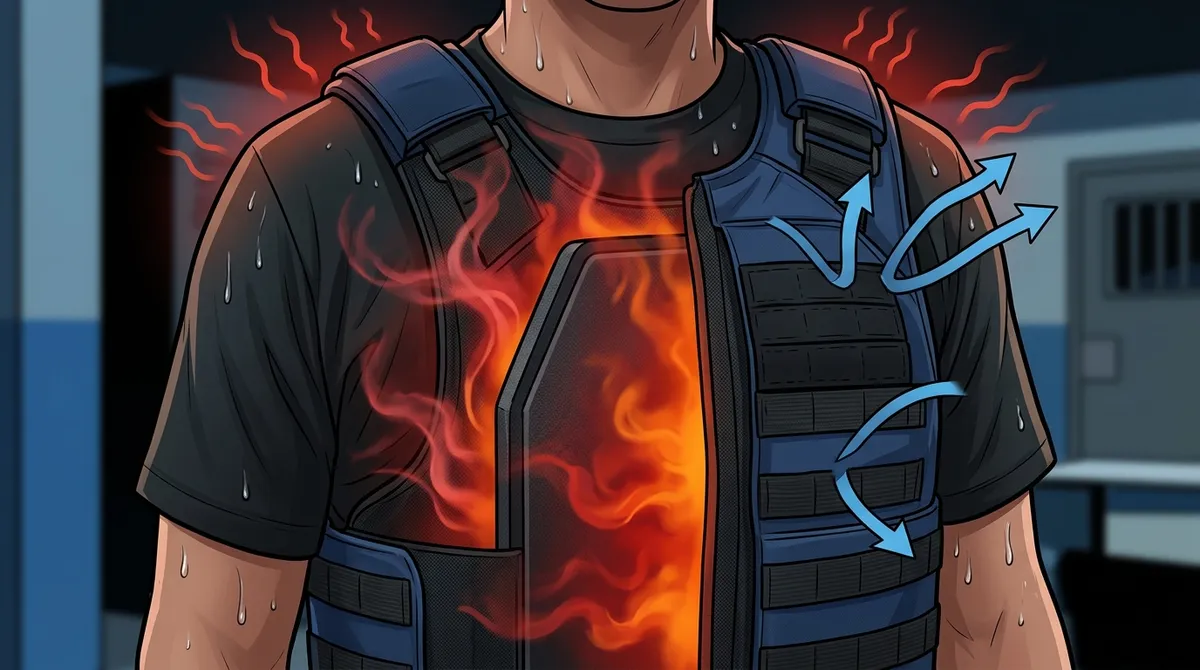
Body armor makes the problem worse. When armor sits directly against your skin, it blocks natural airflow. Your body produces heat and sweat, but there’s nowhere for it to go. The result? You feel hotter, sweat more, and fatigue sets in faster. According to the OSHA Heat Stress Guide, heat buildup in enclosed environments can lead to heat exhaustion and reduced cognitive performance — both serious risks for correctional professionals.
Industry guidance consistently highlights heat management as one of the top reasons officers stop wearing their protective gear consistently. That’s a safety issue, not just a comfort one. Understanding why professionals need a body armor ventilation vest is the first step toward solving the problem.
How Body Armor Traps Heat and Moisture
Body armor is designed to protect you, not breathe. Most stab vests and ballistic vests are made from dense, layered materials that are excellent at stopping threats but very poor at letting heat escape. When you wear armor, your core body temperature rises because sweat can’t evaporate efficiently.
Here’s what happens physically when heat gets trapped:
- Sweat pools against your skin under the vest
- Heat builds up between your torso and the armor
- Moisture creates friction that causes skin irritation and rashes
- Your body works harder to cool itself, draining your energy
- Odor increases from prolonged moisture contact
This cycle repeats every shift. Over time, it can lead to real discomfort, distraction, and even health concerns. The good news? A simple ventilation layer between your body and the armor can break this cycle entirely. Learn more about why professionals struggle with heat under body armor and what can be done about it.
Understanding Ventilation Vests for Body Armor
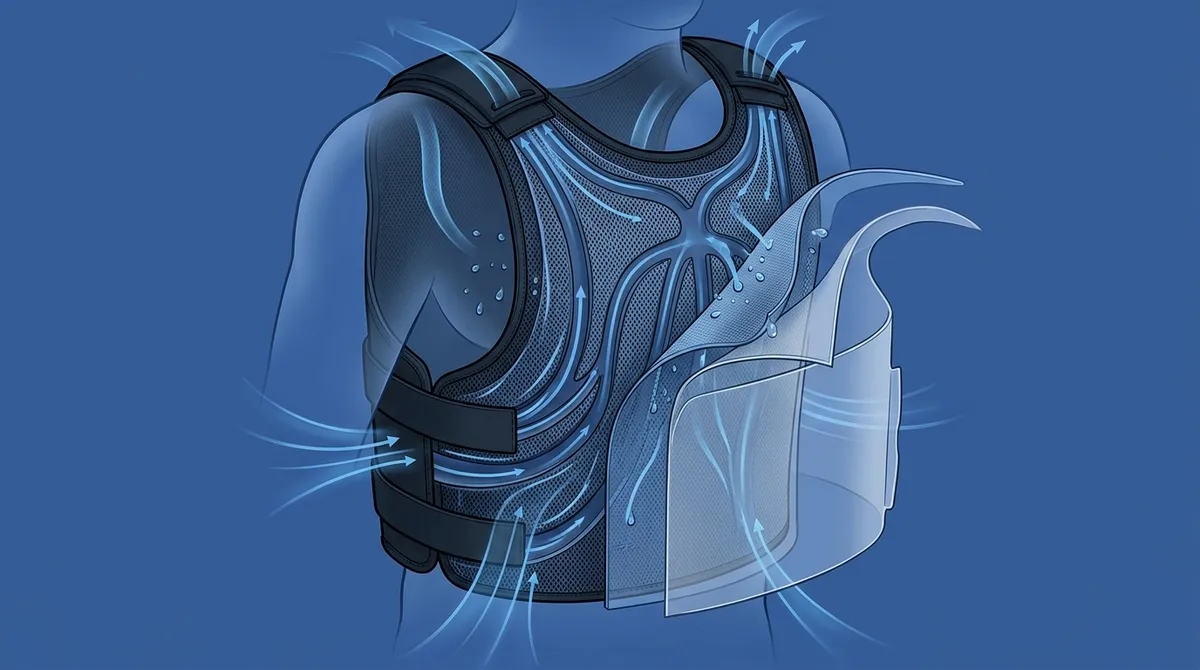
A ventilation vest is not protective armor. It’s a comfort layer worn between your body and your stab vest or plate carrier. Its job is to create a separation gap so air can circulate and heat can escape. Think of it like a thin buffer that keeps armor lifted slightly off your torso, allowing airflow where there was none before.
It’s important to understand that Body Armor Standards from the National Institute of Justice relate only to the protective armor itself — not to ventilation accessories. Ventilation vests are comfort tools used alongside NIJ-rated or stab-rated gear, not instead of it.
There are two main types of ventilation systems available:
Passive Ventilation Systems
Passive systems use mesh spacers, foam channels, or structural designs to create an air gap. They rely on body movement and natural airflow to push air through. These are lightweight and simple to use, but their effectiveness depends on how much you’re moving and the ambient temperature around you.
Active Ventilation Systems
Active systems use battery-powered fans to continuously push air under your vest. This means cooling happens even when you’re standing still — which is common in correctional settings. Active systems deliver more consistent relief in hot, low-airflow environments like prison facilities. You can read a full breakdown at passive vs. active tactical vest ventilation: which wins?

Comparing Ventilation Options for Correctional Officers
| Ventilation Type | How It Works | Best For | Limitations |
|---|---|---|---|
| Passive Mesh Spacing | Structural gap holds armor off skin | Active, mobile officers | Less effective when stationary |
| Foam Channel Design | Channels direct airflow across torso | Budget-conscious users | Durability varies by product |
| Inflatable Air Gap Vest | Inflation lifts armor for cooling on demand | Officers needing low-profile option | Requires pump to inflate |
| Active Fan Ventilation | Battery fan pushes air continuously | Static environments like prisons | Requires charging |
For prison guards specifically, active fan-based systems tend to deliver the most consistent relief because they don’t rely on movement to generate airflow. Learn how active cooling systems work in ventilation vests to understand which option fits your daily routine.
Top Product Picks: BluHalo and BluFano
When it comes to prison guard body armor heat relief, two products consistently stand out. Both are made by BluHalo, a brand built specifically for law enforcement and protective gear wearers who need real cooling relief on long shifts.
BluHalo Ventilation Vest
The BluHalo ventilation vest was created by a Chicago police officer who experienced the same heat frustration you face every shift. It weighs under 7 ounces and sits flat and unobtrusive under your armor when deflated. When you need cooling relief, inflate it with the small pump — it lifts your vest up to 1.5 inches off your body, creating an instant air gap for heat to escape.
Made from double-layer high-strength polyethylene, BluHalo is built for daily duty use. Officers wearing it during 12-hour shifts in 95-degree heat have reported major comfort improvements. It attaches with Velcro and deflates instantly with a button, giving you cooling on demand without slowing you down. At $60, it’s an accessible entry point for correctional officers looking for immediate relief.
BluFano Active Fan System
For maximum cooling power, the BluFano fan system takes things to the next level. It’s a self-contained, active airflow unit with a patented air-redirect spout that slides under any body armor style. A control knob lets you adjust fan speed, and the built-in 10,000mAh power bank keeps the fan running for 8 to 32 hours depending on your setting.
What makes BluFano especially practical for prison guards is that it keeps delivering cool air even when you’re standing at a post or working a static assignment. It also includes a forward-facing light for low-light situations and can charge your USB devices on the go. If you want next-level comfort and longer cooling duration, comparing BluFano vs. BluHalo can help you decide which is the right fit.
BluHalo vs. BluFano: Side-by-Side Comparison
| Feature | BluHalo Vest | BluFano Fan System |
|---|---|---|
| Cooling Method | Inflatable air gap (passive) | Active fan-driven airflow |
| Weight | Under 7 ounces | Compact self-contained unit |
| Battery Required | No | Yes (10,000mAh built-in) |
| Run Time | On-demand inflation | 8–32 hours per charge |
| USB Charging | No | Yes |
| Built-in Light | No | Yes (forward-facing) |
| Price | $60 | Higher tier |
| Best For | Budget-friendly, mobile use | Static posts, max cooling |
Both products can also be bundled together at a discount for maximum cooling performance. Many officers use BluHalo as their primary air gap solution and BluFano to boost active airflow during the hottest parts of their shift.
How to Choose the Right Heat Relief Solution
Picking the right ventilation system for prison guard body armor heat relief comes down to a few key factors. Here’s a simple step-by-step process to guide your decision:
- Assess your environment. Do you work in a hot, enclosed facility with little airflow? Active ventilation will serve you better than passive options.
- Consider your activity level. If your shift involves a lot of standing or static work, you’ll need a fan-based system rather than one that relies on body movement.
- Check compatibility. Make sure the ventilation product works with your stab vest or concealable armor. Most ventilation vests are designed to fit under any standard armor type.
- Think about shift length. For 8-hour shifts, the BluHalo vest may be all you need. For 12-hour shifts in extreme heat, the BluFano’s longer battery life gives you continuous relief.
- Set your budget. Starting with the BluHalo at $60 is a low-risk way to experience real cooling relief before upgrading.
For a deeper dive into making the right selection, check out how to choose corrections officer vest ventilation that works.
Key Benefits of Ventilation Vests for Prison Guards
Here’s a quick summary of what a good ventilation vest does for correctional officers:
- Creates an air gap between your body and armor to allow heat to escape
- Promotes faster evaporation of sweat to reduce moisture buildup
- Reduces skin irritation, rashes, and chafing from prolonged armor wear
- Helps you stay more alert and focused during long, hot shifts
- Makes you more likely to wear your protective gear consistently
- Cuts down on odor from sweat accumulation under the vest
According to industry sources, over 107,000 police officers, first responders, prison guards, and military operators worldwide use ventilation vest systems — a number that reflects just how widespread this problem is and how effective these solutions have become. You can explore more options at body armor cooling solutions for officers in 2026.
Heat Management Tips for Correctional Officers
A ventilation vest works best when combined with smart habits. Here are a few additional tips to help you manage heat on the job:
- Wear moisture-wicking base layers under your ventilation vest to help pull sweat away from your skin
- Stay hydrated throughout your shift — dehydration makes heat stress worse
- Take short breaks in cooled areas when possible to help your body reset
- Keep your armor clean and dry between shifts to prevent bacterial buildup
Combining these habits with a quality ventilation system like BluHalo or BluFano gives you the best possible defense against heat fatigue. For a full look at heat stress prevention, visit how to prevent heat stress while wearing body armor.
What to Expect When You Start Using a Ventilation Vest
| Before Ventilation Vest | After Ventilation Vest |
|---|---|
| Heat builds up quickly under armor | Air gap allows continuous heat release |
| Sweat soaks through and stays | Moisture evaporates more efficiently |
| Skin irritation and rashes develop | Reduced friction and moisture contact |
| Fatigue sets in earlier in the shift | Better comfort supports sustained focus |
| Officers sometimes skip wearing armor | Comfort encourages consistent armor use |
The difference is noticeable from the very first shift. Officers who use ventilation vests regularly report feeling significantly more comfortable and less drained by the end of their day. You can read real experiences at the BluHalo reviews page to hear what fellow correctional and law enforcement professionals have to say.
Final Thoughts on Prison Guard Body Armor Heat Relief
You put on your body armor to stay safe. You deserve to wear it without suffering through hours of trapped heat and sweat. Prison guard body armor heat relief isn’t just about comfort — it’s about staying sharp, staying safe, and doing your job at your best every single shift.
Whether you start with the lightweight, on-demand cooling of the BluHalo vest or jump straight to the advanced, fan-powered relief of BluFano, you’ll notice a real difference. And with the option to bundle both together, you can build a full cooling system tailored to your needs and your facility’s environment.
Ready to feel the difference on your very next shift? Get in touch with the BluHalo team to learn which ventilation solution is right for you, or head straight to the BluHalo shop to get started today. You’ve earned the right to stay cool.
FAQs
Q: What is a ventilation vest for prison guards?
A: A ventilation vest is a comfort layer worn between your body and your stab vest or body armor. It creates an air gap that allows heat and moisture to escape, keeping you cooler and drier during long shifts. It’s not protective armor — it works alongside your existing NIJ-rated or stab-rated gear.
Q: Do body armor cooling vests really work in hot, enclosed facilities?
A: Yes! Ventilation vests are especially effective in confined environments like prison facilities. Active fan-based systems like BluFano are particularly helpful because they push air continuously — even when you’re standing still — rather than relying on movement or outdoor airflow to stay cool.
Q: Can correctional officers wear cooling vests under stab vests?
A: Absolutely. Most ventilation vests are designed to fit under any standard body armor, including concealable stab vests, plate carriers, and ballistic vests. Products like BluHalo and BluFano are built specifically with law enforcement and correctional officers in mind, so compatibility is a top priority.
Q: What is the difference between passive and active body armor ventilation?
A: Passive ventilation relies on natural airflow and body movement to push air through a mesh or structural gap. Active ventilation uses battery-powered fans to continuously circulate air under your vest. For prison guards who often work in static, hot environments, active ventilation tends to deliver more consistent and effective relief.
Q: Are ventilation vests considered protective armor?
A: No — ventilation vests are comfort accessories, not protective gear. They are designed to improve airflow and reduce heat buildup when worn with your existing body armor. Always ensure your primary protective vest meets NIJ or stab-rating standards required for your role, and use a ventilation vest as an add-on for comfort.