Key Takeaways
-
Heat stress under body armor reduces alertness, slows decision-making, and increases heat exhaustion risk—ventilation vests can reduce sweat accumulation by up to 9 times compared to wearing no cooling system.
-
Active fan-powered cooling systems like Blufano run 8-32 hours on a single charge with adjustable speeds, while passive vests require no maintenance but provide effective cooling for only 2-4 hours depending on conditions.
-
Choose cooling systems based on shift length and role: passive spacer vests work for shorter shifts, while active fan systems are essential for 10-12 hour shifts in serious heat with continuous on-demand airflow.
-
Ensure your cooling vest has a low-profile design that fits under existing body armor, duty belt, and radio equipment without restricting movement or shifting protective gear.
-
Combine cooling vests with OSHA-recommended heat safety practices: frequent small water breaks (50-60°F water), scheduled rest periods in shaded areas, and supervisor training to recognize early heat exhaustion signs.
-
Use proper cleaning and maintenance following manufacturer instructions, wear the vest over clean armor to maximize airflow effectiveness, and keep backup battery charges ready for multi-shift assignments.
If you’ve ever stood post for eight hours straight in body armor while the sun beats down, you already know the struggle. Sweat pools where you least expect it, your uniform sticks to your skin, and by hour six, you’re thinking more about the heat than the job in front of you. You’re not alone, and there’s good news: a smart cooling system for security guards can genuinely change how your shift feels.
Whether you’re guarding a warehouse, working armed protective detail, or patrolling a busy event, heat builds up fast under body armor. That trapped heat isn’t just uncomfortable. It can slow your reaction time, drain your energy, and put your safety at risk. This guide walks you through how ventilation vests work, what the research actually says, and how to pick a system that fits your gear and your day. We’ll also cover the simple habits that keep you safer, because a great cooling system works best as part of a bigger plan.
Why Security Guards Overheat Under Body Armor
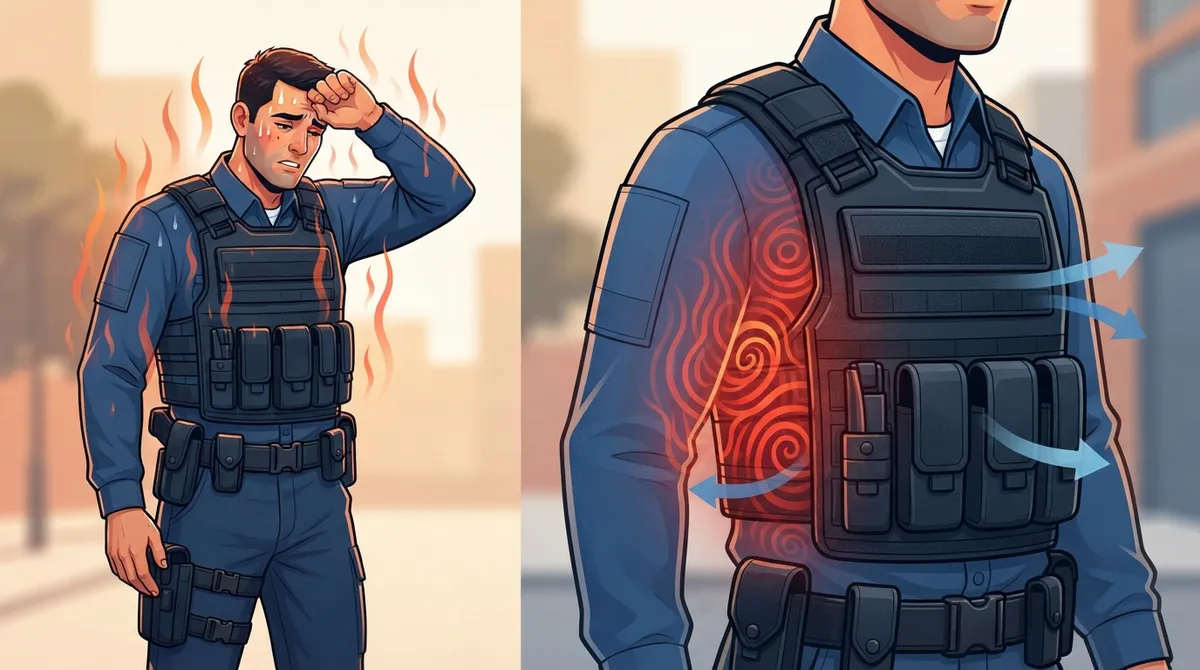
Body armor is built to protect you, not to breathe. That’s just physics. A vest that stops a threat also traps heat and moisture against your torso, according to Body Armor Standards research on protective gear performance. Add a duty belt, radio, and long hours standing or walking, and your body has nowhere for that heat to go.
This isn’t just an annoyance. NIOSH identifies several categories of cooling technology built specifically for workers dealing with this kind of heat burden, including air-cooled garments, water-cooled garments, cooling vests, ice-pack vests, and wetted overgarments. Each one tackles the same problem in a different way, and knowing the differences helps you choose smart.
The Hidden Costs of Heat Stress on the Job
Heat stress does more than make you uncomfortable. It can affect focus, judgment, and physical performance exactly when you need them most. Guards working outdoor posts, event security, or long patrol shifts are especially at risk, since there’s often no quick way to cool down until the shift ends.
- Reduced alertness and slower decision-making during long shifts
- Increased sweat buildup that soaks through uniform layers
- Higher risk of heat exhaustion, especially in humid climates
- Discomfort that distracts from situational awareness
- Fatigue that builds cumulatively across multiple hot shifts
These challenges show up across many roles covered in our guide on why professionals need a body armor ventilation vest, and they apply just as much to security teams as to law enforcement.

How Ventilation Vests Actually Cool You Down
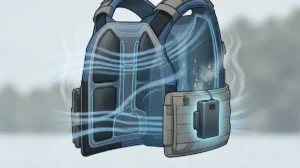
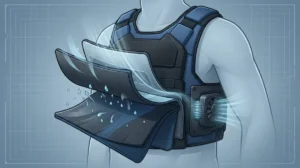
A ventilation vest works by creating an air gap between your torso and your body armor. That gap lets air move freely, which helps sweat evaporate instead of soaking into your clothes. There are two main styles worth knowing.
Passive Ventilation Design
Passive vests don’t use batteries or fans. They rely on mesh channels, spacer materials, or inflatable air chambers to lift your armor slightly off your body. This creates natural airflow as you move. They’re simple, low-maintenance, and there’s nothing to charge.
Active Fan-Powered Systems
Active systems use small, rechargeable fans to push fresh air through channels built into the vest. This gives you continuous airflow, even when you’re standing still at a post with no breeze. Our article on how active cooling systems work in ventilation vests breaks down the mechanics in more detail.
Research backs up how effective this approach can be. A Northumbria University study found that a ventilated vest delivered about 28 watts of cooling during exercise and 73 watts while at rest, when tested at 45°C and 10% relative humidity. Participants in that study also exercised 18% longer with the vest than without it, and their skin temperature under body armor stayed noticeably lower.
What the Research Says About Cooling Performance
It helps to know what science actually supports, so you can set realistic expectations. Here’s a breakdown of key findings from recent studies on cooling vests and ventilation systems.
| Study or Source | Key Finding |
|---|---|
| NIOSH Heat Stress Guide | Cooling vests offer effective cooling for about 2-3 hours, up to 4 hours max |
| Northumbria University (45°C, 10% humidity) | Ventilated vest gave 28W cooling during exercise, 73W at rest |
| 2024 PubMed Prototype Study | Sweat buildup was 9 times higher during guard duty without a vest |
| 2025 Journal of Industrial Textiles Review | Liquid-circulating vest cut skin temp by 3°C over 120 minutes at 42.2°C |
| 2025 Journal of Industrial Textiles Review | Evaporative vest gave mild cooling for up to 3.5 hours at 35°C |
One especially relevant finding comes from a 2024 study on a prototype ventilated vest tested during simulated guard duty. Sweat accumulation in the layer closest to the skin was roughly nine times higher during guard duty without the vest compared to wearing it. Participants also reported feeling noticeably cooler and more comfortable, even though the physiological changes were modest.
Choosing the Right Cooling System for Your Role
Not every guard has the same needs. A guard standing static post in a hot parking lot faces different challenges than one doing foot patrols through a large facility. Here’s how to think through your options.
1. Check Compatibility With Your Existing Gear
Your cooling system needs to fit under your current body armor, duty belt, radio, and ID equipment without restricting movement. A bulky system that shifts your gear out of place isn’t worth the cooling benefit. Look for low-profile designs that stay flat when not in use.
2. Decide Between Passive and Active Cooling
If you want simplicity and no charging required, a passive spacer vest may be enough for shorter shifts. If you’re working 10 or 12-hour shifts in serious heat, an active fan system gives you continuous relief. Our comparison on passive vs. active security personnel ventilation walks through the tradeoffs in detail.
3. Think About Battery Life and Maintenance
Active systems depend on battery life, so check how many hours of runtime you get on a single charge. Some systems offer adjustable fan speeds that stretch battery life from 8 to over 30 hours, which matters a lot for multi-day assignments or back-to-back shifts.
4. Prioritize Durability and Easy Cleaning
Security work is demanding on gear. Look for washable, durable materials that hold up to daily wear. Double-layer, high-tensile construction tends to outlast cheaper alternatives.
Introducing BluHalo and Blufano: Two Trusted Cooling Solutions
At BluHalo, we built our flagship ventilation vest specifically for people who wear body armor every single day. It was designed by a Chicago police officer who got tired of overheating and excessive sweating on long shifts, and it’s become a trusted option for law enforcement, military personnel, and security professionals alike.
The BluHalo ventilation vest weighs under 7 ounces and lies flat when deflated, so it stays unobtrusive under your armor. When you need cooling, a small pump inflates it to lift your vest up to 1.5 inches off your body, creating an instant air gap. A quick-release button deflates it just as fast. It attaches to a clean vest with Velcro, so setup takes seconds, not minutes.
For guards who want continuous, hands-free airflow, Blufano is our advanced fan system. It’s a self-contained active airflow unit with a patented air-redirect spout that slides under any style of body armor. Depending on your fan speed setting, it runs anywhere from 8 to 32 hours on a single charge, thanks to a built-in 10,000mAh power bank. That same battery can charge your phone or radio, and Blufano even includes a forward-facing light for low-visibility situations.
Guards who’ve tried both often bundle them together for maximum comfort, using BluHalo’s on-demand lift alongside Blufano’s continuous airflow. You can browse both options and current bundle pricing in our shop, and see real feedback from users in our customer reviews.
Building a Complete Heat Safety Plan
A great cooling vest is a powerful tool, but it’s not a magic shield against heat illness. The OSHA Heat Stress Guide recommends a full approach that includes hydration, rest breaks, and gradual acclimatization to hot conditions. Here’s a simple plan every security team should follow.
- Provide cool water, ideally between 50-60°F, and encourage guards to drink small amounts frequently throughout the shift.
- Build in scheduled work-rest breaks, especially during peak afternoon heat.
- Set up a shaded or air-conditioned recovery area guards can access during breaks.
- Follow an acclimatization schedule for new guards, starting around 20% heat exposure on day one and increasing gradually.
- Train supervisors to recognize early signs of heat exhaustion, like dizziness, confusion, or excessive sweating that suddenly stops.
- Equip guards with a reliable ventilation vest to reduce heat buildup throughout the shift.
For guards working in extreme climates, our guide on choosing law enforcement gear for hot climates offers more practical tips that apply just as well to private security roles.
Common Mistakes to Avoid
Even with great gear, small mistakes can undercut your cooling performance. Watch out for these common pitfalls.
- Wearing a cooling vest over dirty or sweaty armor, which reduces airflow effectiveness
- Letting battery-powered systems run dry without a backup charge plan
- Choosing a bulky system that doesn’t fit properly under existing gear
- Skipping hydration because you assume the vest alone will prevent heat stress
- Ignoring manufacturer cleaning instructions, which shortens the vest’s lifespan
Our detailed breakdown of security guard body armor cooling mistakes to avoid covers even more ways to get the most out of your investment.
Ready to Stay Cooler on Every Shift
Heat shouldn’t be the reason your shift feels harder than it needs to be. Whether you choose the on-demand lift of BluHalo, the continuous airflow of Blufano, or both together, you’re taking a real step toward staying comfortable, focused, and safer on the job. Thousands of guards, officers, and everyday heroes have already made the switch, and we’d love to help you do the same. Reach out to our team today to get personalized recommendations for your gear setup, and let’s find the cooling system that fits your shift perfectly.
FAQs
Q: What is the best cooling system for security guards wearing body armor?
A: It really depends on your shift length and climate! For most guards, a combination like BluHalo’s on-demand lift and Blufano’s continuous fan airflow gives you the best of both worlds. If you want simplicity, a passive ventilation vest works great too, and it never needs charging.
Q: How long does a security guard cooling vest stay effective?
A: According to NIOSH, most cooling vests provide effective cooling for about 2 to 3 hours, with some lasting up to 4 hours depending on conditions. Active fan systems like Blufano can run much longer, up to 32 hours on a single charge at lower fan speeds, which is perfect for extended shifts.
Q: Can a cooling vest be worn under a stab-proof or bullet-resistant vest?
A: Yes, that’s exactly what these systems are designed for! Both BluHalo and Blufano are built to slide comfortably under any style of body armor, including stab-resistant and bullet-resistant vests, without compromising fit or protection.
Q: Are cooling vests safe to wear with body armor and tactical equipment?
A: Absolutely, as long as you choose a low-profile design that doesn’t shift your armor out of place. Our vests are built to work alongside duty belts, radios, and other tactical gear without interfering with your equipment’s protective function.
Q: Can a ventilation vest prevent heat exhaustion or heat stroke?
A: A ventilation vest is a fantastic tool for reducing heat buildup, but it works best as part of a bigger plan. Pair it with proper hydration, rest breaks, and acclimatization, following guidance like the OSHA Heat Stress Guide, for the most complete protection against heat illness.