Key Takeaways
-
Phase-change ice-pack vests are the heaviest option, adding about 6 to 9 pounds once loaded with packs, while passive ventilation vests add only the weight of their fabric.
-
A fan-powered cooling system in one 2026 listing totals about 965 g (2.1 lb), with the battery (430 g) as the largest single component.
-
Always compare the full ready-to-wear system weight, since brands may list dry weight, weight with packs, or exclude the battery.
-
Evaporative vests gain significant weight when soaked, so check whether a listed weight is dry, wet, or includes cooling packs before comparing.
-
Armor already strains shoulders, back, and hips, so a heavy cooling system can speed up fatigue, making lightweight, low-profile options especially valuable on long shifts.
-
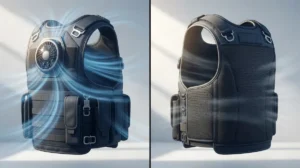
Air-based systems like BluHalo, under 7 ounces and inflated to lift the vest about 1.5 inches off the body, offer a light way to cool without ice or water packs.
You already carry a lot on your body. Armor, radio, belt, mags, maybe a med kit. So when someone says “add cooling gear,” your first thought is probably, “Great, more weight.” That is a fair worry. Every extra ounce matters on a 12-hour shift.
The good news is that the answer is not one number. It depends on how the gear cools you. Some vests add almost nothing. Others add as much as a small bowling ball. If you want to know how much weight does vest cooling gear add, you need to compare the full, ready-to-wear system, not just the garment.
In this guide, we will break down each cooling type, share real product weights from 2026 listings, and show you which options stay light. Whether you patrol a beat, guard a site, serve on a tactical team, or respond to emergencies, you will leave knowing what to expect. Let’s dig in.
Why There Is No Single Weight for Vest Cooling Gear
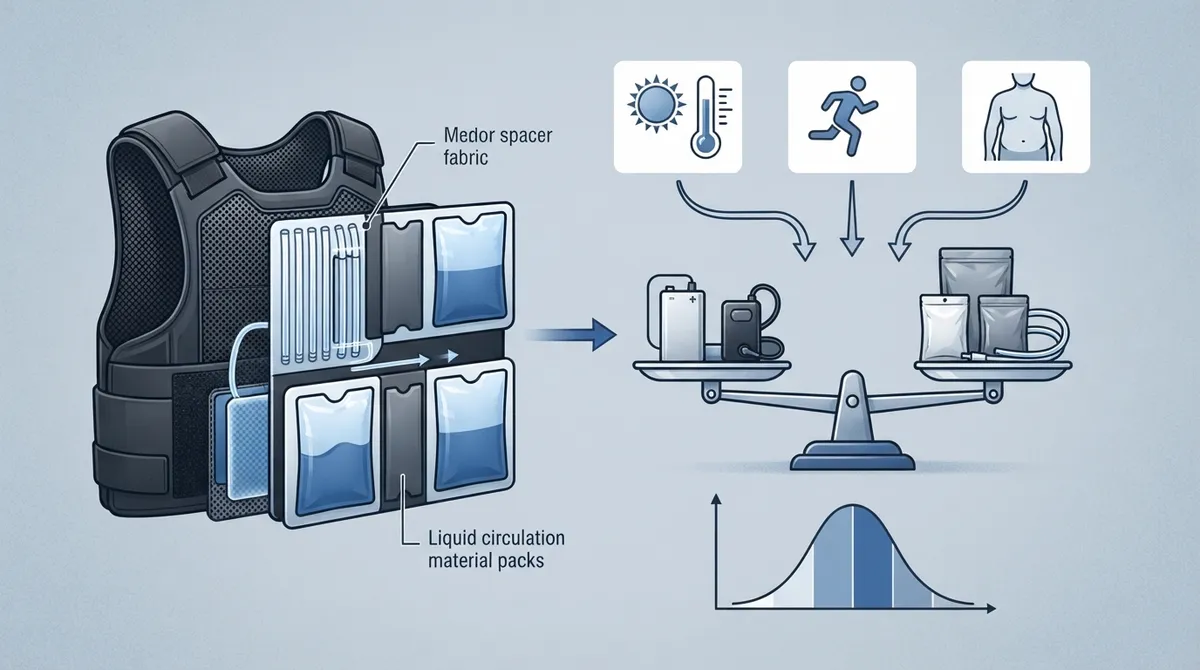
“Vest cooling gear” covers a wide range of products. A thin mesh layer and a vest packed with frozen inserts are very different things. They both aim to keep you cooler, but they get there in different ways.
Four main styles exist today:
- Passive ventilation vests: Mesh or spacer layers that let air move. No packs, no battery.
- Fan-powered systems: A small fan and battery push air under your armor.
- Evaporative vests: Fabric you soak in water. It cools as the water evaporates.
- Phase-change or ice-pack vests: Pockets filled with cooling packs that you chill or freeze first.
Each style adds a different load. Also, brands list weight in different ways. Some list dry weight. Some list weight with packs. Some leave out the battery. Always check what the number actually includes.
Added Weight vs. Total Worn Weight
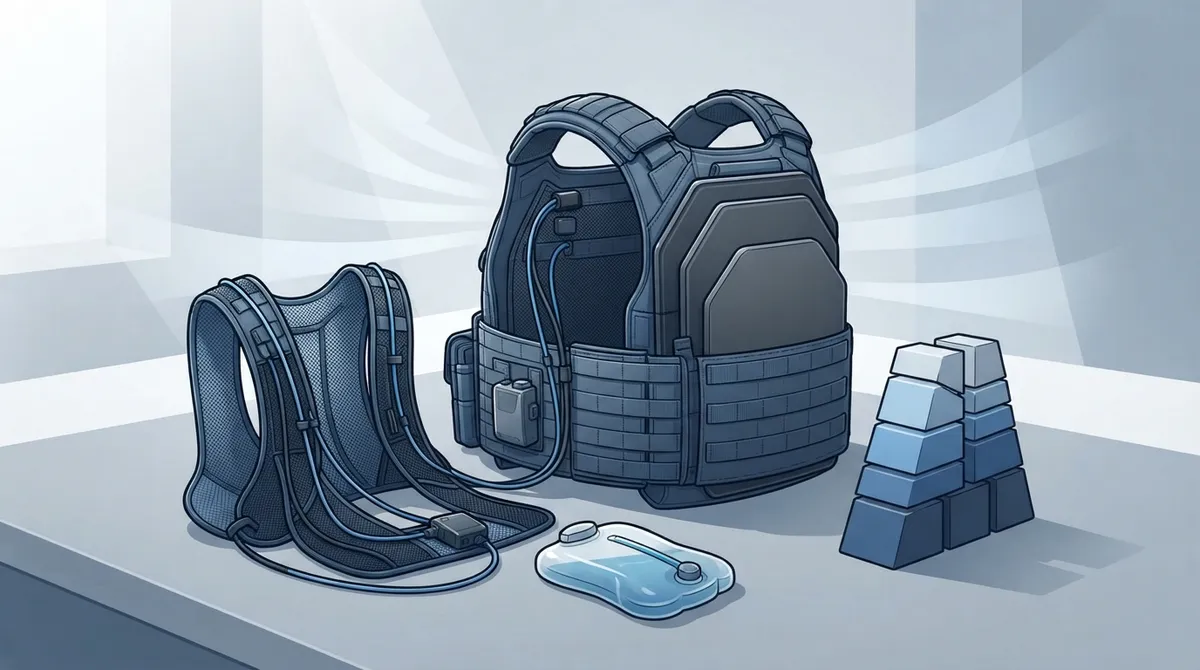
Before we compare products, let’s clear up one common mix-up. Added weight is the weight of the cooling system itself. Total worn weight is everything on your body, including clothes, armor, and gear.
If a cooling system weighs 1 pound, it adds 1 pound. It does not change the weight of your armor. This is why you should ask one simple question: “What does the complete system weigh when I am wearing it?” That means the garment, any water, packs, fans, and battery.
Weight by Cooling Type: A Quick Comparison
Here is a side-by-side look at typical added weight by style. These figures come from manufacturer and catalog listings. They are product-specific examples, not industry-wide averages.
| Cooling Type | What Adds the Weight | Example Weight |
|---|---|---|
| Passive ventilation vest | Garment only | Varies by design; no packs or battery |
| Fan-powered system | Garment, fans, battery | About 965 g (2.1 lb) in one listing |
| Evaporative vest | Fabric plus water or packs | 0.75 lb to 2.25 lb; one industrial vest is 530 g dry and under 2 kg with eight packs |
| Phase-change vest | Vest plus cooling packs | 6 lb to 9 lb (2.7 to 4 kg) in one popular model; 7.05 lb in another |
As you can see, the range is big. A passive layer sits at the light end. A fully loaded pack vest sits at the heavy end.
Passive Ventilation Vests: Just the Garment
A passive ventilation vest is the simplest option. It has no battery, no water, and no packs. The only weight you add is the weight of the fabric or spacer material itself.
There is no reliable industry-wide average for these vests, because designs vary so much. Still, with no extra parts, they sit at the lightest end of the scale. The trade-off is that they rely on your body movement and natural airflow. They cannot actively push air for you.
If you want to understand the trade-offs, our guide on passive vs. active tactical vest ventilation walks through when each style makes sense.
Fan-Powered Systems: Light, but Not Zero
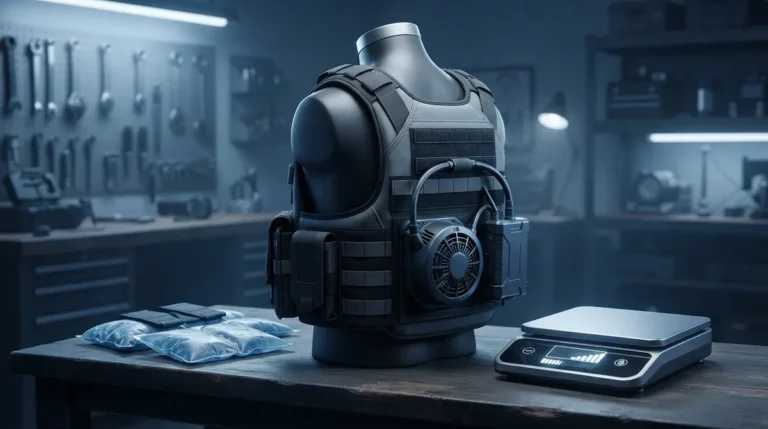
Fan systems add a few extra parts. You get the garment, the fan unit, and a battery. Let’s look at a real example from a 2026 manufacturer listing:
- Vest garment: 305 g
- Fan accessories: 230 g
- Battery: 430 g
- Total: about 965 g (2.1 lb)
That is about the weight of a large water bottle. For many wearers, that is a fair price for steady, on-demand airflow. And because the fan keeps air moving, you are not waiting on ice to melt or fabric to dry.
Not every fan system is built the same, though. Battery size is usually the biggest driver of weight. A bigger battery runs longer, but it weighs more.
Evaporative Vests: Light Dry, Heavier Wet
Evaporative vests have a sneaky weight pattern. They feel light in the box. Then you soak them, and the weight goes up.
One industrial vest lists 530 g (about 1.2 lb) when empty. With its eight cooling packs in place, it comes in under 2 kg (4.4 lb). Other catalog listings show evaporative vests from 0.75 lb to 2.25 lb. Those numbers may reflect different models or setups, so compare carefully.
Here is what to check on any evaporative vest listing:
- Is the weight dry, soaked, or with inserts?
- Does it include packs?
- Does it fit under armor or over it?
Evaporative cooling also works best in dry air. In humid weather, it can feel damp without cooling much. That is worth thinking about before you buy.
Phase-Change and Ice-Pack Vests: The Heavy Hitters
These vests cool by holding frozen or chilled packs against your torso. They can feel great at first. But they carry the most weight.
The Ergodyne Chill-Its 6215 lists 6 lb (2.7 kg) for S/M and 9 lb (4 kg) for L/XL with packs. Another phase-change system is listed at 7.05 lb (3.2 kg). A TST Sweden cooling vest spec lists 1.7 kg for XS/M and 2.1 kg for L/2XL in one configuration.
Think about that for a second. A 9 lb vest is like wearing a gallon of milk and a half on your chest, on top of your armor. Over a long shift, that adds up fast. These packs also stop cooling once they warm up, so you may need to swap them out.
What This Means for Armor Wearers
If you wear body armor, weight matters in a special way. Armor already pulls on your shoulders, back, and hips. Adding several pounds on top can make fatigue show up sooner.
Heat is a big part of that fatigue. The OSHA heat stress guidance explains how heat strain builds when your body cannot shed warmth. So there is a real balance here. A cooling system that is too heavy can wear you down. But no cooling at all can wear you down faster.
The best approach is to look for cooling that is light, low-profile, and works without bulky packs. Our deep dive on how to prevent heat stress while wearing body armor covers more ways to stay safe in the heat.
How BluHalo and Blufano Keep the Load Light
This is where air-based cooling really shines. Instead of loading you up with ice or water, it makes space and moves air.
The BluHalo ventilation vest weighs under 7 ounces. That is lighter than a typical smartphone with a case. It sits flat under your armor when deflated. When you need relief, you inflate it with a small pump, and it lifts the vest up to about 1.5 inches off your body. That gap lets heat escape and air flow. A button deflates it fast so it lies flat again. It was created by a Chicago police officer who lived this problem, and it is built from durable double-layer high-strength polyethylene.
The Blufano fan system adds active airflow. A patented air-redirect spout slides under any style of body armor. It has adjustable fan speeds and runs for 8 to 32 hours depending on the setting. A built-in 10,000mAh power bank powers the fan and can also charge USB devices. There is even a forward-facing light for low-light situations.
Together, they give you cooling on demand plus steady airflow, without the heavy packs. If you want to see how they stack up, read BluFano vs BluHalo. You can also buy both together at a bundle discount to boost cooling performance.
How to Compare Weight Like a Pro
When you shop, do not trust the first number you see. Use this simple checklist:
- Find the system weight. Look for the full ready-to-wear number, not just the garment.
- Check dry vs. wet. Evaporative vests gain weight when soaked.
- Add the battery. Fan systems often list the battery separately.
- Count the packs. Phase-change vests can double in weight once loaded.
- Match the size. Large sizes often weigh more than small ones, as the Ergodyne example shows.
- Ask the maker. Manufacturer specs are the best source for a specific model.
Taking a few minutes to do this can save you from buying gear that feels fine in the store but drags on the job.
Match the Weight to Your Job
Different roles can handle different loads. Here is a simple way to think about it:
- Patrol and security shifts: You move a lot and sit in cars. Light, low-profile gear works best. Our guide on choosing the best police vest ventilation system can help.
- Tactical and SWAT work: Every ounce counts during fast, intense action. Skip heavy packs and choose slim, active airflow.
- Military use: Long missions in high heat call for light gear and long battery life. See how body armor heat management for military use works in the field.
- Emergency response: You need cooling that works fast and does not add bulk. Check emergency responder gear that keeps you cool.
You can also learn how standards shape armor safety on the National Institute of Justice body armor page. Any cooling gear you add should never get in the way of how your armor fits or performs.
Light Gear, Cool Body, Clear Head
So, how much weight does vest cooling gear add? It can be as little as the weight of the garment itself, or it can be 9 pounds or more. Passive vests are lightest. Fan systems land around 2 pounds in one example. Evaporative vests range from under a pound to a few pounds once loaded. Phase-change vests are the heaviest at 6 to 9 pounds.
If you want cooling without the drag, air-based options like BluHalo and Blufano are a smart place to start. They keep the load low and the airflow high, so you can focus on the job. Ready to find the right setup for your shift? Get in touch with our team and we will help you pick the best fit. You can also browse the shop to see the full lineup.
FAQs
Q: How much does a cooling vest weigh when fully loaded?
A: It depends on the type. A fan-powered system can be around 2 pounds, while phase-change vests with packs can reach 6 to 9 pounds. Always check the full ready-to-wear weight for your exact model.
Q: How much weight does a fan cooling vest add with its battery?
A: In one 2026 listing, the garment is 305 g, the fans are 230 g, and the battery is 430 g. That totals about 965 g, or 2.1 pounds, before any extras.
Q: Are ventilation vests lighter than ice-pack or phase-change vests?
A: Yes, by a lot. A passive ventilation vest adds only its own fabric weight, while phase-change vests can add several pounds once the packs are loaded. Air-based options like BluHalo, at under 7 ounces, stay on the light end.
Q: How much heavier does an evaporative cooling vest get when wet?
A: It varies by model. One industrial vest weighs 530 g dry and under 2 kg with its eight cooling packs. Check whether a listed weight is dry, soaked, or includes inserts before you compare.
Q: What is the lightest type of cooling vest for work?
A: Passive ventilation vests and inflatable air-gap designs are the lightest because they skip heavy packs and water. BluHalo weighs under 7 ounces and lifts your vest up to about 1.5 inches off your body for airflow.